Showing posts with label farmland. Show all posts

Wednesday, July 29, 2015

7/29 BC boats, Inslee acts, warm waters, fish collapse, oil push, Edelman, human measure, Vic sewer, Tesoro, drought

Salish-class ferries (BC Ferries/Times Colonist)
B.C. Ferries announces names of new Salish-class ships
The mid-size ferries joining the B.C. Ferries fleet starting in 2016 will form the new Salish class of vessels. B.C. Ferries announced Tuesday that the Salish class name applies to all three vessels being built at a Polish shipyard for a total cost of $165 million. The three 351-foot vessels will be called Salish Orca, Salish Eagle and Salish Raven. Carla Wilson reports. (Times Colonist)

Inslee: I’ll use my authority to impose cap on emissions
Frustrated by legislative inaction on climate, Gov. Jay Inslee plans to wield his administration’s executive authority to impose a binding cap on carbon emissions in Washington state. Inslee on Tuesday directed the state Department of Ecology to step up enforcement of state pollution laws and develop the emissions cap — aimed at enforcing greenhouse-gas-reduction targets that have been in state law since 2008. Jim Brunner and Hal Bernton report. (Seattle Times)

Puget Sound waters reach record warm temperatures
Puget Sound has reached the highest temperatures on record based on 25 years of data, the state Department of Ecology announced Tuesday. Scientists are seeing unusual conditions in the sound as a result of the statewide drought and the pool of unusually warm water in the northern Pacific Ocean some are calling “the blob.” Warming waters are increasing harmful algae blooms and shellfish closures, lowering the oxygen content of the water and creating unfavorable conditions for salmon and other marine species. (Skagit Valley Herald)

Sockeye face 'catastrophic' collapse in South Okanagan
A potentially catastrophic collapse of the sockeye salmon run is unfolding on the Columbia River system this year. Scientists once predicted that about 100,000 sockeye would return to spawning grounds in the rivers and streams in British Columbia's South Okanagan region. In fact, it was supposed to be one of the largest sockeye runs in recent history, said Okanagan Nation Alliance fish biologist Richard Bussanich. But Bussanich said the latest projection falls short of earlier expectations. Instead, it's now thought that only 18,000 sockeye will return this year. He said higher water temperatures and low water levels are stressing the migrating salmon. (CBC)

Big oil push for crude exports could bring more oil trains through Washington state
Right now, U.S. companies are not allowed to export crude oil. But if some very powerful oil companies get what they want, that could be about to change. If that happens, Washington state could become a major portal for crude exports. Last week, top executives of four leading U.S. oil companies sent a joint letter to the chairman of the House Energy and Commerce Committee, pressing for repeal of the 30-year ban on crude oil exports. Steve Wilhelm reports. (Puget Sound Business Journal)

GPT: Departure of PR firm Edelman ‘won’t impact anything’
News broke late last week in environmentalist social media circles that Edelman, reportedly the world’s largest public relations firm, had dropped Gateway Pacific Terminal as a client. Gateway Pacific Terminal is the coal port proposed on a 1,500-acre site at Cherry Point. At full capacity, it would ship 48 million metric tons of coal annually to overseas markets, primarily in Asia. The story appeared initially in Environment and Energy Publishing, an independent news site that is all but inaccessible to the hoi polloi due to subscription rates that range from $2,000 to $150,000 a year. But some advocacy groups are subscribers, and the news did filter down to Bellingham environmentalists. Ralph Schwartz reports. (Bellingham Herald)

State Agency Adding Human Well-Being To Puget Sound Health Indicators
Humans should be part of any consideration of how well Puget Sound’s ecological recovery is going. How we’re thriving and benefiting are critical parts of the equation, according to new research conducted for the state agency in charge of the cleanup. The agency, called Puget Sound Partnership, is adding indicators of human well-being and quality of life to the “vital signs” it tracks. They’ll be included on the colorful pinwheel “dashboard” that anyone can see online. Bellamy Pailthorp reports. (KPLU)

Westside sewage committee asks for extension to look at sites
The westside sewage committee wants more time to evaluate site options — and it’s banking on a centralized treatment option in the eastside to keep funding out of jeopardy. The westside committee voted Tuesday to submit a full technical analysis of short-listed sites by the end of October, instead of September, as outlined in its PPP Canada $83-million funding agreement. The core area liquid waste management committee will consider the plan today. Co-chairwoman of the westside Barb Desjardins said the extra time is about getting the right technical information, not delaying the process. Amy Smart reports. (Times Colonist)

Tesoro to enter chemical business with new project
n a few years, your polyester jacket could be made, in part, by a chemical extracted from crude oil at the Tesoro Refinery. It’s called xylene and can be found in just about any hardware store. The liquid solvent is already being extracted by other refineries and sold overseas to be made into polyester for plastics and clothing, but the Anacortes refinery will be the first in the Tesoro family to expand its repertoire, entering into the chemical business. Shelby Rowe reports. (Skagit Valley Herald)

Snoqualmie Valley farmers fight drought with innovation
…. Twenty minutes east of Seattle, (the Snoqualmie Valley) is home to multiple small and organic farmers who feed much of Puget Sound’s insatiable appetite for chemical free fruits, vegetables, eggs and poultry. Like every farm in every county across the state, Local Roots is struggling to access enough water this year. Farm owners Siri Erickson-Brown and Jason Salvo, a 30-something couple with advanced degrees, have farmed in this valley for nine years. They’ve seen 100-year floods wash out fields in consecutive years, and record cold on one Fourth of July. But they’ve never seen a year like this – record heat combined with soil so dry they’ve had to exhaust virtually every water resource available. Martha Baskin reports. (Crosscut)

Now, your tug weather--
WEST ENTRANCE U.S. WATERS STRAIT OF JUAN DE FUCA- 255 AM PDT WED JUL 29 2015
TODAY
W WIND TO 10 KT...BECOMING 5 TO 15 KT IN THE AFTERNOON. WIND WAVES 2 FT OR LESS. W SWELL 4 FT AT 10 SECONDS.
TONIGHT
W WIND 5 TO 15 KT...BECOMING NW TO 10 KT AFTER MIDNIGHT. WIND WAVES 2 FT OR LESS. W SWELL 4 FT AT 9 SECONDS.
--
"Salish Sea News & Weather" is compiled as a community service by Mike Sato. To subscribe, send your name and email to msato@salishseacom.com. Your email information is never shared and you can unsubscribe at any time.

Salish Sea News: Communicate, Educate, Advocate

Follow on Twitter.

Salish Sea Communications: Truth Well Told

Monday, July 13, 2015

7/13 Eulachon, farm drought, research trawl, BC LNG debate, oil train monitoring, Ketron Is estate

Eulachon (Northword)
‘Salvation Fish’ That Sustained Native People Now Needs Saving
…. This is the last great eulachon fishery on Earth, near the mouth of the Nass River in British Columbia, just at the tip of the Alaska Panhandle. Eulachon are a species of smelt, each fish a bolt of silver-blue not much longer than a ballpoint pen. In lean years the eulachon's arrival meant the difference between life and death…. Today, the fish that used to safeguard native people from starvation is itself in need of a lifeline. J.B. MacKinnon reports. (National Geographic)

Farmers’ profits could sustain a hit reaching the millions
Hot, dry weather and a shortage of water are taking their toll on the county’s agriculture industry. Some crops may never recover. The yield loss in Skagit County this year could be 30 percent, said Don McMoran, director of the Washington State University Skagit County Extension. If that happens, local farmers could lose $6 million in profits. While many county farmers get their water from wells — and the majority can take as much as they need up to their permit amount — others have restricted water rights. Then there are those who have no access to irrigation, making them especially vulnerable to the early warm weather. Shelby Rowe reports. (Skagit Valley Herald)

If you like to watch: Studies of bottom fish help fill in key portions of Puget Sound food web
n a new video, Dayv Lowry of the Washington Department of Fish and Wildlife does a great job explaining how scientific trawling provides information about the kinds of creatures that hang out on the bottom of Puget Sound. The video shows a big net being brought to the surface filled with crabs and all sorts of strange creatures, which are then sorted and measured right on the deck of the Chasina. This research, which has been going on for years, provides information about how populations of marine species are changing over time. Chris Dunagan reports. (Watching Our Water Ways)

B.C. legislature to debate law on 25-year LNG deal
The B.C. legislature will hold a rare summer sitting Monday to debate an unprecedented 25-year liquefied natural gas agreement projected to be the cornerstone of the province's financial future. The government plans to pass legislation enabling the $36 billion deal with Pacific NorthWest LNG, a consortium led by Malaysian energy giant Petronas. The consortium wants to build an LNG export terminal near Prince Rupert. The agreement would protect the business from tax increases made specifically to target the LNG industry. (CBC) See also: LNG protest attracts dozens of boaters to Horseshoe Bay  Coalition of citizens groups says Howe Sound wrong place for an LNG plant (CBC)

Whatcom County environmentalists want to monitor oil trains
Whatcom County environmentalists want to step in as watchdogs and keep tabs on the trains rolling through their backyards. For a few months, RE Sources for Sustainable Communities staff members have asked people who are interested in environmental activism if they own property near the tracks, and if they’d be willing to host a camera there to document train movements. Samantha Wohlfeil reports. (Bellingham Herald)

Landmark Ketron Island estate sells to Lacey couple
A 5-acre estate with 1,000 feet of waterfront, commanding views of Puget Sound and the Olympics and a midcentury home built in the style of renowned architect Frank Lloyd Wright on the northern tip of Ketron Island has sold to a Lacey couple.... The new owners are Thurston County restaurateurs Nicole Pham and her husband Jim Porter, according to Karen Vincent who handled the sale for Morrison House Sotheby’s International Realty. The estate originally was listed for $1.77 million. Then it was reduced to $1.299 million. It sold for $1.1 million. John Gille reports. (Tacoma News Tribume)

Now, your tug weather--
WEST ENTRANCE U.S. WATERS STRAIT OF JUAN DE FUCA- 300 AM PDT MON JUL 13 2015
TODAY
LIGHT WIND...BECOMING NW 5 TO 15 KT IN THE AFTERNOON. WIND WAVES 2 FT OR LESS. W SWELL 3 FT AT 9 SECONDS. A SLIGHT CHANCE OF
 SHOWERS.
TONIGHT
W WIND 5 TO 15 KT AFTER MIDNIGHT. WIND WAVES 2 FT OR LESS. W SWELL 3 FT AT 9 SECONDS.

--
"Salish Sea News & Weather" is compiled as a community service by Mike Sato. To subscribe, send your name and email to msato@salishseacom.com. Your email information is never shared and you can unsubscribe at any time.

Salish Sea News: Communicate, Educate, Advocate

Follow on Twitter.

Salish Sea Communications: Truth Well Told

Thursday, July 9, 2015

7/9 Herons, Elwha water, farm water, Marina Beach plan, smoke, Skagit farmland, Latino climate

(PigeonPoint.Org)
When predator turns protector at B.C.’s largest heron colony in Tsawwassen
It’s the closest thing to Jurassic Park, a wooded bluff on the Tsawwassen First Nation lands that is home to B.C’s largest great blue heron nesting colony. Hundreds of them fly overhead like pterodactyls, distinguished by their hoarse, raucous calls, hunched silhouettes and outstretched wings. By any definition, this is a remarkable place. What makes it even more extraordinary is the fact that the herons have formed an unlikely alliance with their sworn enemy — the bald eagle — to protect their young even as they lose some to predation. Larry Pynn reports. (Vancouver Sun)

Port Angeles considering stricter city water curbs to protect fish; other sources studied
City officials are pondering imposition of stricter, Stage 3 water conservation measures within the next three weeks as the Elwha River flows slower and slower during the North Olympic Peninsula’s rainless summer, Craig Fulton, city public works and utilities director, said Wednesday. Fulton told City Council members Tuesday that the city also is looking at other options for city water other than the Elwha River so the waterway remains vibrant for fish. Fulton said the river is flowing at 340 cubic feet per second (cfs) two months ahead of schedule. Paul Gottlieb reports. (Peninsula Daily News)
 
Ecology approves transfer of water rights to help farmers
The state Department of Ecology approved Wednesday a water rights transfer to help Skagit County farmers. Farmers in Drainage and Irrigation Improvement District No. 15 and Consolidated Diking Improvement District No. 22, which are west of Mount Vernon and Conway, will receive 1.6 million gallons of Skagit River water a day from the Skagit Public Utility District through Sept. 30. The transfer comes eight days after the city of Anacortes agreed to transfer the rights to 4.8 million gallons of water a day through Sept. 30 to the two districts. (Skagit Valley Herald)

Final open house for Marina Beach Master Plan presents preferred scheme for park, Willow Creek
At the third and final open house on the Marina Beach Master Plan, approximately 40 participants were presented with the final preferred plan for developing and enhancing the park, a major feature of which is a free-flowing, salmon-supporting Willow Creek. The previous open houses in March and May drew almost 200 participants, who provided the consultant team with feedback on design proposals and alternatives. Larry Vogel reports. (My Edmonds News)

Cooling Smoke
Cliff Mass writes: "Tuesday was almost comfortable over much of Northwest Washington today... but why? One of the reasons might be unexpected:  the Northwest part of Washington State had a relatively thick layer of smoke overhead.  It almost seemed like an overcast day...but there were no clouds, but plenty of smoke from the British Columbia fires…. Smoke like this tends to cool the surface by scattering some of the solar radiation back to space…. Weaker sun means less warming. Well, if this theory is correct we should be able to see it in the high temperatures yesterday...let's check it out. South of Seattle there are lots of temperatures between 82 and 85F.  This is true even with some cooler marine air and low clouds pushing into that area Tuesday AM.  But north of Seattle most land stations east of the Sound and Georgia Strait were in the 70s--Bellingham was only 72F! (Cliff Mass Weather Blog)

Another 1,000 acres of farmland to be preserved from development
Another 1,000 acres of Skagit County farmland will be preserved forever against development after funding was included last week in the state’s capital budget. The Legislature approved about $1.3 million, and the Skagit County Farmland Legacy Program, which protects local agriculture, will match the funding. The 1,000 acres will be added to 9,500 acres of Skagit County farmland — out of about 100,000 total acres — that have been preserved against development since 1996. The 9,500 acres come from 194 farms. Shelby Rowe reports. (Skagit Valley Herald)

Majority of Latinos see global warming as serious problem, poll shows
A large majority of Latinos see global warming as a serious problem - a view that crosses party lines and includes Republicans, whose party leaders are climate change skeptics. More than 73 percent of U.S. Latinos surveyed by the Florida Atlantic University Business and Economics Polling Initiative consider global warming to be a somewhat serious or very serious problem. Concern is higher among Democrats - 82 percent than among Republicans at 62.2 percent. Concern is much lower - 49 percent - among Latinos who are independents or not registered. Anthony Man reports. (Sun Sentinel)

Now, your tug weather--
WEST ENTRANCE U.S. WATERS STRAIT OF JUAN DE FUCA- 308 AM PDT THU JUL 9 2015
TODAY
W WIND 5 TO 15 KT. WIND WAVES 2 FT OR LESS. SW SWELL 3 FT AT 18 SECONDS. PATCHY FOG IN THE MORNING.
TONIGHT
W WIND 10 TO 20 KT...EASING TO 10 KT AFTER MIDNIGHT. WIND WAVES 1 TO 3 FT...SUBSIDING TO 1 FT OR LESS AFTER MIDNIGHT. SW SWELL
 3 FT AT 18 SECONDS. AREAS OF FOG AFTER MIDNIGHT.

--
"Salish Sea News & Weather" is compiled as a community service by Mike Sato. To subscribe, send your name and email to msato@salishseacom.com. Your email information is never shared and you can unsubscribe at any time.

Salish Sea News: Communicate, Educate, Advocate

Follow on Twitter.

Salish Sea Communications: Truth Well Told


Wednesday, July 1, 2015

7/1 Auklet, Shell drill, microplastics, Navy, Columbia R. future, Pierce Co. farmland

Whiskered Auklet (Sergey Frolov/BirdNote)
The Auklet's Whiskers - Not Just for Show
In Alaska’s Aleutian Islands, thousands of Whiskered Auklets — miniature relatives of puffins and murres — nest in deep rock crevices. The birds owe their name to the white plumes that sprout from their heads each summer. These fancy “whiskers” likely play a role in courtship. But they're not just for show. Much like the whiskers of a cat, the plumes are acutely sensitive, guiding the auklets through the dark nest cavities. When nesting is done, the auklets will return to the open sea and molt their multi-purpose whiskers. Until the next spring.(BirdNote)

Shell clears key Arctic drilling hurdle, but must keep its rigs 15 miles apart
Shell Oil has cleared one more key regulatory hurdle in seeking to drill in the Arctic this summer, as the oil giant received a “letter of authorization” (LOA) from the U.S. Fish & Wildlife Service regarding potential disturbance to polar bears and walruses. The letter allows Shell to “take small numbers of polar bears and Pacific walrus incidental to activities” it plans for drilling this summer in the Chukchi Sea, about 75 miles northwest of the native village of Wainwright, Alaska. Joel Connelly reports. (SeattlePI.Com) See also: Shell oil-drilling ship leaves Everett, bound for Arctic June 30  (Everett Herald)

Microplastic particles move up marine food chain on B.C. coast: research
Plastic fibres and particles in West Coast waters are being consumed and passed up the food chain by tiny marine creatures that apparently mistake them for food, according to a new study from the Vancouver Aquarium Marine Science Centre. Researcher Peter Ross and his colleagues found plastic litter in the digestive systems of two key species of plankton that are eaten in large numbers by salmon and baleen whales. Adult salmon returning to the Strait of Georgia may be consuming up to 91 plastic particles a day by eating plankton, and juveniles leaving fresh water up to seven particles a day, while a humpback whale could ingest more than 300,000 particles a day, according to the researchers’ estimates. Randy Shore reports. (Vancouver Sun)

Navy enjoys Northwest building spree but faces lawsuits and other challenges
New jets. New ships. New piers stretching into Hood Canal. They’re just some of the big-ticket items the Navy has bought for its bases around the Puget Sound area. After a dozen years of Army growth and the end of a $2 billion wartime investment at Joint Base Lewis-McChord, Navy Region Northwest is on its own building spree. It’s spending hundreds of millions of dollars improving facilities ranging from the wharf that handles nuclear missiles at Naval Base Kitsap-Bangor to the hangars on Whidbey Island set to receive some of the military’s latest aircraft. Adam Ashton reports. (Olympian)

Energy decisions loom over the Columbia River
Stand on the cliffs overlooking the wild beauty of the Columbia River, viewed by many as one of the most significant environmental forces in the Pacific Northwest, and you’ll get a glimpse of why its rapid transformation into a fossil fuel axis is cause for rising cries of alarm. Coal from the Rocky Mountains, oil from Alberta’s tar sands, and crude from North Dakota’s Bakken shale fields are being transported through the area at an unprecedented rate, putting the area at risk of major spills and explosions. Railroads are now moving an estimated 60 times more oil annually than they were during the period from 2005 to 2009. Martha Baskin reports. (Crosscut)

Pierce County looks to hold the line on protected farmland
The Pierce County Council will vote Tuesday on a proposal that would maintain, for now, the status quo for long-term preservation of agricultural lands in East Pierce County. The measured approach is in contrast to several drastically different alternatives that sparked months of debate about how much acreage should be classified as Agricultural Resource Lands. The ARL designation is meant to protect “commercially significant” farmland from being paved over by developers for years to come. Currently, about 23,000 acres are classified as ARL in areas such as Graham, Eatonville, Orting and Roy. Kari Plog reports. (Tacoma News Tribune)

Now, your tug weather--
WEST ENTRANCE U.S. WATERS STRAIT OF JUAN DE FUCA- 300 AM PDT WED JUL 1 2015
TODAY
LIGHT WIND. WIND WAVES LESS THAN 1 FT. NW SWELL 7 FT AT 8 SECONDS...SUBSIDING TO 5 FT AT 8 SECONDS.
TONIGHT
W WIND TO 10 KT IN THE EVENING...BECOMING LIGHT. WIND WAVES 1 FT OR LESS. NW SWELL 5 FT AT 8 SECONDS.

--
"Salish Sea News & Weather" is compiled as a community service by Mike Sato. To subscribe, send your name and email to msato@salishseacom.com. Your email information is never shared and you can unsubscribe at any time.

Salish Sea News: Communicate, Educate, Advocate

Follow on Twitter.

Salish Sea Communications: Truth Well Told

Thursday, February 26, 2015

2/26 WA pipe, oil train queries, Shell woes, BC LNG, salmon status, non-tangible fish, OR marine life, Howe Sound ship, Barnaby Reach, grizzlies, H2O2, Matlock farm

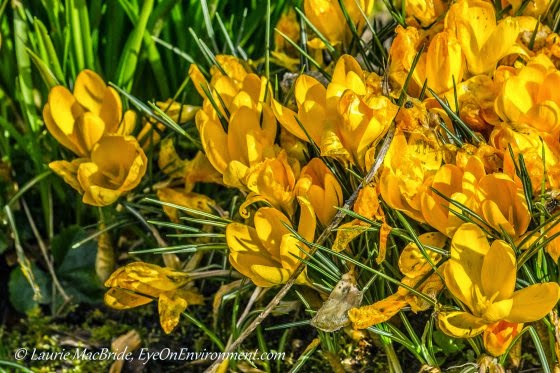
(PHOTO: Laurie MacBride)
Emerging from the Decay
Laurie MacBride in Eye on Environment writes: "I love crocuses. They pop up all over the garden every February, bright and cheerful no matter what the weather might be doing. Our yellow crocuses come first, followed a week or two later by their paler, but no less beautiful purple cousins. Both serve as a reminder that spring is just around the corner, helping to bring a smile and a lighter step after the wet, dreary months of winter…."

Senate bill would look to install crude oil pipeline across Washington state
A state senator introduced a bill today that would require Washington to look at building pipeline to move crude oil through the state. “We need to move oil across our state and there is a lot of concern about oil-by-rail,” said Sen. Michael Baumgartner, R-Spokane, in an announcement Wednesday, Feb. 25. “It’s time to look at a trans-Washington oil pipeline.” Sen. Doug Ericksen, R-Ferndale, is a co-sponsor of the bill, which would require a study of the safest pipeline route to the state’s oil refineries from the Midwest, e.g. the Bakken region in North Dakota and Montana. Samantha Wohlfeil reports. (Bellingham Herald)

Unanswered questions about oil trains
Two questions popped up Tuesday at a Washington House committee hearing on an oil train safety bill. No one could answer them. The first came from Bob Rudolph, a resident of Steilacoom, a Pierce County city where a railroad line lies next to Puget Sound. He asked: Are there any plans to deal with a possible train accident spilling oil into Puget Sound? The hearing room held railroad, oil industry and government emergency officials, none of whom could answer. The other question at the House Finance Committee hearing came from Rep. Larry Springer, D-Kirkland. He asked: If an oil train wrecked in an area crisscrossed by the jurisdictions of several local and state agencies, how long would it take to get a unified command in place? Six hours? Three days? Barnaby Dow, representing the King County Office of Emergency Management department, said the county has the resources to deal with such an emergency. But he did not know how long it would take to set up a unified command structure. John Stang reports. (Crosscut)

Anacortes refinery plan may hit another roadblock
An environmental review isn't the only challenge Shell faces with its Anacortes refinery. Betting on the long-term viability of Bakken oil is risky. Jon Talton reports. (Seattle Times) See also: Shell Puget Sound getting new general manager Tom Rizzo, site general manager of Shell Puget Sound Refinery, will leave his position March 1 and will be replaced by Shirley Yap, who comes to Anacortes with 20 years of experience. Shannen Kuest reports. (Skagit Valley Herald)

B.C. LNG projects unlikely to produce by 2020: analysts
Just a week into the new year, Natural Gas Development Minister Rich Coleman declared British Columbia’s nascent liquefied natural gas industry would “take flight” in 2015. He said he expected to see three plants in production by 2020 as the province had set the “playing field” for development of the new industry. Measures included a new LNG income tax that had been cut in half and rules that set benchmarks for greenhouse gas emissions. Last week, the federal government sweetened the pot, announcing it would introduce an accelerated capital tax allowance measure that would provide savings to companies. But despite the latest tax measure from Ottawa, there is little likelihood that three plants will be in operation by 2020, say industry analysts. Gordon Hoekstra reports. (Vancouver Sun)

New Report Shows Status of Salmon Recovery
Salmon recovery efforts in Washington are making a difference – more salmon are returning home in some areas, although significant work remains – according to a new report released by the Governor’s Salmon Recovery Office. The newly released State of Salmon in Watersheds Executive Summary and interactive Web site show Washington’s progress in trying to recover the 15 populations declared as at risk of extinction by the federal government and listed under the Endangered Species Act. The Web site puts online live data from many sources around the state and offers interactive story maps from efforts statewide. (San Juan Islander)

In Overturning Conviction, Supreme Court Says Fish Are Not Always Tangible
A narrowly divided Supreme Court on Wednesday sided with a Florida fisherman, throwing out his conviction for tossing evidence — undersize grouper — back into the Gulf of Mexico under a federal law aimed mostly at white-collar crime. The fisherman, John L. Yates, was convicted of violating the Sarbanes-Oxley Act of 2002, which imposes a maximum sentence of 20 years for the destruction of “any record, document or tangible object” in order to obstruct an investigation. In two opinions, five justices accepted Mr. Yates’s argument that fish were not the sort of tangible objects with which the law was concerned. Their analysis was based on a close reading of the words and structure of the law. Adam Liptak reports. (NY Times)

Japanese Fish Found Alive In Oregon Waters
Oregon scientists are trying to figure out how a fish, native to Japan, was pulled out of a crab pot on the Oregon coast - alive. “I’ve been thinking about it ever since I heard about it,” says John Chapman, an invasive species expert at the Hatfield Marine Science Center. He says there’s only a handful of ways the striped knifejaw could make it here: in the ballast water of a ship; someone could have dumped their aquarium into the ocean; or the fish survived under debris washed out to sea after the Japanese tsunami. Kristian Foden-Vencil reports. (OPB) And, oooh: Great white shark lurking near Washington State's Ocean Shores (CBC)

Permit to sink former warship in Howe Sound questioned in Federal Court
A lawyer for a group opposed to the sinking of a former warship off the coast of British Columbia says Environment Canada failed to adequately consider whether the vessel contained toxic chemicals. Martin Peters represents the Save Halkett Bay Marine Park Society, which is fighting in Federal Court to quash a permit that Environment Canada issued last October to the Artificial Reef Society of B.C., allowing it to sink the ship. The reef society is aiming to tow the 1960s vessel from Long Bay to Halkett Bay Marine Park on Gambier Island, where it would be sunk to create an artificial reef for divers and marine life. (Canadian Press)

Concerns raised over Barnaby fish proposal on Skagit
A proposal to restore fish passage in a section of the upper Skagit River was met with heated discussion at a public meeting Monday evening. While landowners and families that live in the potential project vicinity say they have abundant concerns and frustrations with the proposal’s direction so far, project proponents say Monday’s discussion was a good place to start. Their goal over the long term is to improve fish habitat in the area near Rockport, known as the Barnaby Reach, with the least impact to nearby residents. But for now they aim to work with the people who live there to develop a project all parties can support. Kimberly Cauvel reports. (Skagit Valley Herald)

Agencies are working to restore grizzlies to their natural range
There's an effort under way to help ensure grizzly bears don't become extinct in the North Cascades. The National Park Service and the U.S. Fish and Wildlife Service are working with other agencies on a plan to bring grizzly bears back to this part of their natural range. That includes many of Snohomish County's prominent peaks, such as Mount Pilchuck and Whitehorse Mountain. The grizzly bear restoration effort comes 40 years after the animals were listed in 1975 under the Endangered Species Act as threatened in the lower 48 states. Amy Nile reports. (Everett Herald)

Ecology: 9,600 gallons of hydrogen peroxide spilled from tank at Port of Olympia
A recent chemical spill at the Port of Olympia was larger than first reported, according to state Department of Ecology documents obtained through a public records request. The documents also shed light on the strength of hydrogen peroxide that spilled from a tank at the port’s marine terminal about noon on Jan. 28. The spill led to a large emergency response. S everal businesses within a quarter-mile of the marine terminal were evacuated; some employees were asked to stay indoors. Rolf Boone reports. (Olympian)

In Record-setting Deal, More Than 153 Acres Of Farmland Preserved In Pierce County
More than 153 acres along the Puyallup River will be preserved forever as farmland and wildlife habitat. It's the biggest agriculture conservation deal in the history of Pierce County. The farmland has been in the Matlock family since the mid-1940s. During the height of operation they grew more than one million pounds of berries a year and hired thousands of school children to help bring in the harvest and learn what a day’s work on a farm felt like. For the last 16 years, the family has leased out the land to other farmers. A few years ago, Ivan Matlock, who is now 81, was looking to get the family out of the agriculture business for good and put in a call to Forterra, a nonprofit conservation group. Jennifer Wing reports. (KPLU)

Now, your tug weather--
WEST ENTRANCE U.S. WATERS STRAIT OF JUAN DE FUCA- 232 AM PST THU FEB 26 2015
TODAY
SE WIND TO 10 KT...BECOMING E 10 TO 15 KT IN THE AFTERNOON. WIND WAVES 2 FT OR LESS. W SWELL 5 FT AT 12 SECONDS. SHOWERS LIKELY.
TONIGHT
SE WIND 5 TO 15 KT. WIND WAVES 2 FT OR LESS. W SWELL 5 FT AT 11 SECONDS. SHOWERS.
--
"Salish Sea News & Weather" is compiled as a community service by Mike Sato. To subscribe, send your name and email to msato@salishseacom.com. Your email information is never shared and you can unsubscribe at any time.

Salish Sea News: Communicate, Educate, Advocate

Follow on Twitter.

Salish Sea Communications: Truth Well Told
Tuesday, December 30, 2014

12/30 Monarch butterflies, Fraser farms & fish, erosion & slides, fish crossings

Monarch butterfly (TexasEagle/Flickr/EarthFix)
Feds Consider Endangered Species Listing For Monarch Butterfly
The monarch butterfly is in line for possible protection under the Endangered Species Act. The U.S. Fish and Wildlife Service announced Monday it is launching a year-long status review of the monarch population in response to a request from conservation groups. The iconic butterflies face threats from pesticide use and habitat loss – particularly from the loss of milkweed plants, which are the sole food source for monarch caterpillars. Cassandra Profita reports. (EarthFix)

Probe prompts some farmland owners to improve fish habitat (with video)
Two farmland owners in the Fraser Valley have conducted wide-ranging remediation work — and a third is under a provincial order to do so — following a lengthy Vancouver Sun investigation into the environmental impact of farming on fish streams. The Sun’s Minding The Farm series, published in June, probed several cases in which farmers had altered important fish habitat, and it also exposed the B.C. government’s lax laws on farm manure runoff into fish streams compared with neighbouring Washington state. Larry Pynn reports. (Vancouver Sun)

Erosion damages popular Burien park
Erosion is causing a lot of damage at popular Burien park and it keeps getting worse. A large staircase is about to topple over into Puget Sound and now neighbors are wondering if there's anything the city can do to fix the problem. There would ordinarily be dozens of people running the steps at Eagle Landing Park. But lately there have been just a handful and they're not getting very far. Todd Land reports. (KING) See also: Whidbey slide damage could take time to clean up  (KING)

What's up with those fish crossing signs?
Deer Crossing signs alert motorists to be on the lookout for reckless ruminant mammals. But Fish Crossing signs? Andrea Brown reports. (Herald of Everett)

Now, your tug weather--
WEST ENTRANCE U.S. WATERS STRAIT OF JUAN DE FUCA- 1134 PM PST MON DEC 29 2014
TUE
E WIND 10 TO 20 KT...EASING IN THE AFTERNOON. WIND WAVES 1 TO 3 FT...SUBSIDING. W SWELL 2 FT AT 13 SECONDS.
TUE NIGHT
SE WIND TO 10 KT. WIND WAVES 1 FT OR LESS. W SWELL 2 FT AT 12 SECONDS.
--
"Salish Sea News & Weather" is compiled as a community service by Mike Sato. To subscribe, send your name and email to msato@salishseacom.com. Your email information is never shared and you can unsubscribe at any time.

Salish Sea News: Communicate, Educate, Advocate

Follow on Twitter.

Salish Sea Communications: Truth Well Told

Monday, December 29, 2014

12/29 Pinto abalone, Hood Canal geoduck, Partnership, oil route, birds, global warming, ferry reservations

Pinto abalone (Josh Bouma/PS Restoration Fund)
No endangered listing for prized pinto abalone
The National Marine Fisheries Service has declined to list a prized 6-inch Pacific Ocean marine snail as an endangered or threatened species. The federal agency announced this week that its status review found the pinto abalone is not currently in danger of extinction and does not warrant federal protection under the Endangered Species Act at this time. Pinto abalone, valued for its delicate flavor and mother-of-pearl shell, are found from Alaska to Baja California. Two conservation groups petitioned the agency in July 2013 to conduct a status review for pinto abalone. Phuong Le reports. (Associated Press)

Proposal for Hood Canal geoduck farm dropped
A controversial proposal for a geoduck and oyster farm on Hood Canal is being pulled. The Kitsap Sun reported that according to Kitsap County planners, Scott Kimmel, the owner of New Day Fisheries, has decided not to pursue permit applications for the project. The Poulsbo fisherman had been seeking approval for a geoduck farm he installed without permits on private tidelands in 2013. Kimmel said he didn't know he needed permits to plant more than 9,000 geoduck seeds in plastic tubes embedded in the sand just north of Naval Base Kitsap-Bangor. (Associated Press)

Partnership perspectives on Puget Sound's future
The seven-member Leadership Council is the governing board for the Puget Sound Partnership, which is charged with restoring Puget Sound to health by the year 2020. Members were asked to provide brief written statements about their visions for the future. (Kitsap Sun)

Gulf Islands landowners retain natural sites, reap tax savings
The meadow down the steep side of Mount Elizabeth on Robert and Francis Rose’s North Pender Island property is one of their favourite places to spend time…. That meadow is now protected in perpetuity. In exchange for placing a covenant on their land, the Roses receive an annual 65 per cent property tax exemption through the Natural Area Protection Tax Exemption Program (NAPTEP), administered by the Islands Trust Fund…. The Roses, who are in their mid-70s, are among 23 landowners who have joined the program since its launch in 2005, according to the Islands Trust Fund. Amy Smart reports. (Times Colonist)

Race to build on Columbia River could block Pacific oil route
Some environmentalists are pushing a $1.3 billion real estate project along the Columbia River as a way to stop a proposed oil train plan. Kirk Johnson reports. (NY Times)

States, cities brace for global-warming fallout
Eroding beaches and the seawater that laps onto the Embarcadero waterfront during high tide - not to mention severe storm flooding - were sending a clear message to a city surrounded by water on three sides. San Francisco responded in September, when its Capital Planning Committee decreed that in all future construction projects, city and county agencies, including low-lying San Francisco International Airport, must acknowledge the rising sea level and come up with plans to adapt to. The sea level around San Francisco rose nearly 8 inches in the past century, and it is projected to rise by as much as 55 more inches by 2100. Rita Beamish report. (Stateline.org)

Ladner beats Victoria in annual Christmas count of bird species
Greater Victoria lost its title for finding most species in B.C.’s annual Christmas bird count by a single species. Bird watchers in Ladner, Victoria’s traditional rival, counted 141 species this year, compared with Greater Victoria’s 140…. The Christmas bird count is conducted on any one day from Dec. 14 to Jan. 5 within a 24-kilometre diameter area that stays the same from year to year. There were 21 teams out in the radius centering on the Marigold area of Saanich this year, some of which had more than 15 members fanning out for the count. (Times Colonist) See also: A tally of tail feathers  Bob Kuntz and Kraig Kemper stood behind their scopes Saturday morning at the bay shore near Bay View State Park. They were among more than 60 people who participated in the National Audubon Society’s 115th annual Christmas Bird Count at Padilla Bay. (Skagit Valley Herald)

A bird’s-eye view of bald eagles
So far this season, wildlife experts say the bald eagle population that winters on the upper Skagit River appears to have returned in even stronger numbers than seen last year. While the birds have been sweeping into the east Skagit Valley for more than a month, U.S. Forest Service, National Park Service and Eagle Watchers representatives say they expect plenty of people to flock there to see them in January. Kimberly Cauvel reports. (Skagit Valley Herald)

As Canada Goose Populations Recover, Northwest Farmers Pay The Price
Canada Geese have made a significant comeback in the West. But as the population increases, it’s farmers in Oregon and Washington who are paying the price for the recovery. Seven different subspecies of the Canada geese travel along a metaphorical superhighway, called the Pacific Flyway, from summer nesting grounds in Alaska down into Washington, Oregon and California. The cackling Canada goose is one them. In the 1980s there were only about 25,000 left. But now wildlife officials say the population is averaging more than a quarter million. Jes Burns reports. (EarthFix)

Discover Puget Sound’s past during Archeology Day
The history of humans living along Puget Sound during the past 500 years will be the focus of Archaeology Day Jan. 10 at the Burke Museum. Visitors will have the opportunity to learn about recent archaeological discoveries, how archaeology is used to study the past and the present and see some of the research being done in local communities. (Bellingham Herald)

San Juan ferry reservations available now
Ferry officials hope a reservation system to begin serving the San Juan Islands will greatly reduce long waits and long lines at the ferry terminals, and encourage travelers to take off-peak runs. The “Save a Spot” system, years in the planning, will make reserved spots available on all westbound sailings from Anacortes, and eastbound sailings from Friday Harbor and Orcas Island. Jack Broom report. (Seattle Times)

Now, your tug weather--
WEST ENTRANCE U.S. WATERS STRAIT OF JUAN DE FUCA- 300 AM PST MON DEC 29 2014
GALE WARNING IN EFFECT THROUGH THIS EVENING
TODAY
E WIND 20 TO 30 KT...RISING TO 25 TO 35 KT. SEAS 6 TO 9 FT WITH A DOMINANT PERIOD OF 14 SECONDS.
TONIGHT
NE WIND 25 TO 35 KT...EASING TO 20 TO 30 KT AFTER MIDNIGHT. SEAS 5 TO 7 FT WITH A DOMINANT PERIOD OF 14 SECONDS.
--
"Salish Sea News & Weather" is compiled as a community service by Mike Sato. To subscribe, send your name and email to msato@salishseacom.com. Your email information is never shared and you can unsubscribe at any time.

Salish Sea News: Communicate, Educate, Advocate

Follow on Twitter.

Salish Sea Communications: Truth Well Told

Thursday, December 18, 2014

12/18 Carbon cap, Vancouver soil, tropical species, Sequim water, Saanich sewer, Black Press, sage grouse

Southern Resident Killer Whale Salmon Initiative
Want to make a difference in restoring the health of the endangered Southern Resident killer whales? Over 2,624 people have signed an online petition asking Washington Governor Jay Inslee to support removing the four lower Snake River dams to save the Southern Resident killer Whales from being dammed to extinction. No dams, more fish, healthy whales. Sign on!


Inslee Reveals Plan For Curbing Washington’s Greenhouse Gas Emissions
Washington Gov. Jay Inslee rolled out an aggressive plan Wednesday to cap carbon emissions and fight climate change. The centerpiece of the governor’s strategy would set a statewide limit for greenhouse gas emissions. Big emitters would pay for credits to cover their emissions if they exceed that cap. In later years, these carbon polluters would have the ability to trade those credits on a regional carbon market, potentially joining California, British Columbia and Oregon. Inslee said the plan will generate up to $1 billion for the state, which would pay for transportation, education and community aid. Inslee is expecting his plan to be met with opposition. Ashley Ahearn reports. (EarthFix) See also: Whatcom senator stands in the way of Gov. Inslee’s cap-and-trade climate proposal  Ralph Schwartz reports. (Bellingham Herald)

Vancouver’s native soil ‘too contaminated to grow in,’ SoleFood founder warns
The native soil in Vancouver’s community gardens may be no worse than soils used in rural areas for commercial agriculture, but SoleFood founder Michael Ableman still wouldn’t grow food in it. People’s “romantic perception” that rural areas are somehow pristine environments where all is clean and pure is misplaced. Randy Shore reports. (Vancouver Sun)

Turn of the Tides Festival celebrates marine life, winter solstice
The South Sound Estuary Association will hold its second annual Turn of the Tides Festival, a celebration of the winter solstice, Saturday. The free event will include marine life displays, environment education, arts and crafts, chowder and hot chocolate…. The event will run from 11 a.m.-3 p.m. at the South Sound Estuarium, 309 State Ave. NE, Olympia. For more information, go to sseacenter.org. (Olympian)

Scientists Report Rare Sightings Of Tropical Species Off West Coast
Scientists surveying whales and dolphins on the West Coast have discovered unusual species of birds and marine mammals far north of their normal ranges. Experts say fish and wildlife are being drawn northward by unusually warm ocean water. Every few years, scientists with the National Oceanic and Atmospheric Administration take a head count of whales, dolphins and porpoises in the ocean off California, Oregon and Washington. Cassandra Profita reports. (EarthFix)

County leads effort for cleaner water
Bringing an 18-month project to a close, those involved with creating a Pollution Identification and Correction (PIC) Plan for the Sequim Bay-Dungeness Watershed Clean Water District have completed the draft plan and soon will begin a pilot project near Dungeness Bay. The PIC plan provides the skeleton for how water pollution problems will be identified and corrected with the intention to improve local water quality and health of Sequim and Dungeness bays. Alana Linderoth reports. (Sequim Gazette)

Saanich sewer and water fees going up
Saanich councillors have approved an increase of 11.9 per cent in the sewer charge, which translates into the average homeowner’s bill increasing to $405 from $362. Bill Cleverley reports. (Times Colonist)

Black Press purchases Island newspapers in deal with Glacier Media
Glacier Media Inc. has sold its Vancouver Island Newspaper Group to Victoria-based Black Press. Black Press takes operational control of that group on March 2. That includes Cowichan Valley Citizen, Nanaimo Daily News and Alberni Valley Times. The sale does not include the Times Colonist. Carla Wilson reports. (Times Colonist)

Protections blocked, but sage grouse work goes on
U.S. wildlife officials will decide next year whether a wide-ranging Western bird species needs protections even though Congress has blocked such protections from taking effect, Interior Secretary Sally Jewell said Wednesday. They could determine the greater sage grouse is heading toward possible extinction, but they would be unable to intervene under the Endangered Species Act. The bird's fate instead remains largely in the hands of the 11 individual states where they are found. President Barack Obama signed a $1.1 trillion spending bill late Tuesday with a provision that barred money from being spent on rules to protect the chicken-sized bird and three related types of grouse. Matthew Brown reports. (Associated Press)

Now, your tug weather--
WEST ENTRANCE U.S. WATERS STRAIT OF JUAN DE FUCA- 230 AM PST THU DEC 18 2014
SMALL CRAFT ADVISORY IN EFFECT FROM 10 AM PST THIS MORNING THROUGH LATE TONIGHT
TODAY
SE WIND 5 TO 15 KT...RISING TO 15 TO 25 KT IN THE AFTERNOON. WIND WAVES 1 TO 3 FT...BUILDING TO 3 TO 5 FT IN THE
 AFTERNOON. NW SWELL 6 FT AT 13 SECONDS. A CHANCE OF RAIN IN THE MORNING...THEN RAIN IN THE AFTERNOON.
TONIGHT
S WIND 15 TO 25 KT. WIND WAVES 2 TO 4 FT. W SWELL 7 FT AT 11 SECONDS. RAIN.
--
"Salish Sea News & Weather" is compiled as a community service by Mike Sato. To subscribe, send your name and email to msato@salishseacom.com. Your email information is never shared and you can unsubscribe at any time.

Salish Sea News: Communicate, Educate, Advocate

Follow on Twitter.

Salish Sea Communications: Truth Well Told

Tuesday, May 27, 2014

5/27 Geoduck ban, San Juan Monument, Southlands OK'd, fish consumption, invasives

Spring harvest (Laurie MacBride)
Of Rhubarb and Time Travel
Laurie MacBride in Eye on Environment writes: "Marcel Proust found his time machine in that little sponge cake called a Madeleine. For me, time travel comes from a nibble of fresh, uncooked rhubarb. Steamed rhubarb is nice, especially with yogurt, and I adore rhubarb crumble. But neither holds the power of rhubarb eaten raw: one tiny bite, and I’m instantly transported to the back porch of our old house on Musgrave Avenue. There I sit, a stick of fresh rhubarb in one hand, and in the other, a small cup of white sugar for dipping the rhubarb. Ah, bliss!..."

China To Lift Ban On West Coast Shellfish
China will lift its ban on imports of geoduck clams and other shellfish from the West Coast, according to a statement from Washington Congressman Derek Kilmer... Chinese officials sent a letter Friday to the National Ocean and Atmospheric Administration advising the federal agency the ban would be lifted. The letter stated Chinese officials were satisfied with NOAA’s proposed plans for new monitoring and testing requirements for paralytic shellfish poisoning and inorganic arsenic, which would meet China’s food safety requirements. Tony Schick reports. (EarthFix)

If you like to watch: Puget Sound in the Spring...
Laura James shares her underwater sights and sounds. Enjoy.

The Bureau of Land Management is hosting a series of gatherings this week to discuss the management of the San Juan Islands National Monument. Lopez - Tuesday, May 27, 6-9pm at Lopez Center; San Juan - Wednesday, May 28, 6-9pm at the Grange; and Orcas - Thursday, May 29, 6-9pm at Eastsound Firehall. The meetings will be hosted by local BLM staff along with District Manager Daniel Picard, District Planner Chris Carlton and Planning Assistant Anjolene Price. Read the Draft Interim Management Policy and make your views known.

Tsawwassen farmland development plan gets okay in Metro Vancouver vote
Metro Vancouver has approved a controversial development on a piece of Tsawwassen farmland, despite reservations from some directors that the move could set a dangerous precedent and lead to similar deals by land speculators in other parts of the region. Directors voted 93-31 Friday to amend the regional growth strategy to allow Delta to change the agricultural land-use designation to urban and conservation to allow construction of 950 homes and community gardens on the site known as Southlands. The move, which required a two-thirds majority vote, ends a decades-old battle over the Southlands site, which is not in the Agricultural Land Reserve but is considered to be largely unproductive farmland. Under the deal, 80 per cent of the land would be handed over to Delta for public ownership along with a $9 million contribution from Century Holdings' Sean Hodgins for improved drainage. Kelly Sinoski reports. (Vancouver Sun)

State’s appetite for fish stirs battle over industry, environment
A bitter fight over how much fish people eat — and thus how clean Washington waters should be — has pitted tribes, commercial fishermen and environmental groups against Boeing, business groups and municipalities. The state Department of Ecology appears ready to boost the current fish-consumption rate, an obscure number that has huge ramifications for the state because it drives water-quality standards. A higher number means that fewer toxic pollutants would be allowed in waters. Phuong Le reports. (Associated Press)

Can US eliminate invasive species by eating them?
It seems like a simple proposition: American lakes, rivers and offshore waters are filling up with destructive fish and crustaceans originally from other parts of the world, many of them potential sources of food. So why not control these invasive populations by getting people to eat them? Ramit Plushnick-Masti reports. (Associated Press)

Now, your tug weather--
WEST ENTRANCE U.S. WATERS STRAIT OF JUAN DE FUCA- 243 AM PDT TUE MAY 27 2014
TODAY
W WIND 10 KT. WIND WAVES 1 FT OR LESS. W SWELL 4 FT AT 8 SECONDS. SLIGHT CHANCE OF SHOWERS.
TONIGHT
W WIND 10 TO 20 KT...BECOMING SW TO 10 KT AFTER MIDNIGHT. WIND WAVES 1 TO 3 FT...SUBSIDING TO 1 FT OR LESS AFTER
 MIDNIGHT. W SWELL 4 FT AT 9 SECONDS. SLIGHT CHANCE OF SHOWERS... THEN A CHANCE OF SHOWERS AFTER MIDNIGHT.

--
"Salish Sea News & Weather" is compiled as a community service by Mike Sato. To subscribe, send your name and email to msato@salishseacom.com. Your email information is never shared and you can unsubscribe at any time.

Salish Sea News: Communicate, Educate, Advocate

Follow on Twitter.

Salish Sea Communications: Truth Well Told

Thursday, April 10, 2014

4/10 Salmon quotas, BC tidal power, sewage plants, oil-train safety, BC farmlands, PS Action Agenda, Everett polluter, VanAquarium captives, otter flu, BC landslides

Salmon life cycle (Wikipedia)
New Quotas Clear Way For Banner Summer Salmon Fishing In Pacific Ocean
A federal fisheries management panel approved what some charter captains are calling the best ocean fishing season in 20 years. Meeting at a hotel in Vancouver, Washington, the Pacific Fishery Management Council on Wednesday adopted the 2014 season quotas unanimously after days of lengthy negotiations between commercial troll and recreational fishing representatives, treaty tribes and government regulators. The quotas are a big turnaround from the recent past when ocean salmon fishing was sharply curtailed or not allowed at all. Tom Banse reports. (KPLU)

Island company hopes to harness tides for power
Western Tidal Holdings has applied to the province for permission to investigate installing undersea turbines to generate power at sites close to Trial Island and Race Rocks. The projects are part of a suite of 14 tidal-power projects the Nanaimo-based company is proposing on B.C.’s coast. Last year, the company made similar applications for another site near Race Rocks, as well as sites in Active Pass and a location between Mayne and Pender islands. Those applications are still under review. Andrew Duffy reports. (Times Colonist)

Project at sewage treatment plant forges ahead near Chambers Bay
Four tower cranes up to 175 feet tall soar above a maze of concrete and rebar at Pierce County’s sewage treatment facility, where a $353 million expansion is in full swing. The project next to Chambers Bay golf course in University Place will expand sewage capacity to accommodate growth. And it will allow the county to meet anticipated stricter environmental rules. Workers will take a break before the crowds arrive for the 2015 U.S. Open golf championship. Steve Maynard reports. (News Tribune of Tacoma)

B.C. environment minister loath to take on sewage mess
The Capital Regional District will ask the province to set aside Esquimalt’s bylaws so the CRD can build a sewage treatment plant at McLoughlin Point. But Environment Minister Mary Polak said she’s unlikely to get involved. “Certainly, we will review whatever request they forward to us, but I am not inclined to intervene in what is, ultimately, a decision that should be made by local governments,” Polak said. Bill Cleverley and Lindsay Kines report. (Times Colonist)

Sen. Murray seeks safety assurances as state oil-train transport increases
The U.S. Senate on Wednesday held the first congressional hearing focused solely on the safety of transporting crude oil by rail — an issue that hardly existed a decade ago and which reached Washington state only in 2012. The hearing, chaired by Democratic Sen. Patty Murray, of Washington, was prompted by a recent spate of oil-train accidents that have followed a resurgent domestic production driven by the Bakken shale oil and gas boom. Kyung M. Song reports. (Seattle Times) See also: Communities not prepared for risks of crude oil train derailments, Congress told  (McClatchy)

Opposition grows to BC government's plan to weaken farmland protection
The chorus of opposition to the B.C. government's planned rewrite of the agricultural land reserve is growing. A letter with more than 100 signatures, mostly from academics, biologists and naturalists, has been sent to Premier Christy Clark critical of Bill 24, which was introduced in the legislature on Mar. 27. The letter contends that the bill "reduces the ability for science to inform land use decisions...will increase pressure to remove land from the reserve at a cost to the general good" and overlooks the importance of farmland as habitat for wildlife and endangered species. Larry Pynn reports. (Vancouver Sun)

Public invited to learn about 2014-15 Puget Sound Action Agenda updates
Community members are invited to learn more about the Puget Sound Action Agenda and revised Near Term Actions for 2014-15 at one of two public open houses: April 15: 5 to 7 p.m.  at the Center for Urban Waters, 326 East D St., Tacoma; April 16: 5 to 7 p.m. at the Edmonds Library, Plaza Room, 650 Main Street, Edmonds. More on the updates (Puget Sound Partnership)

Department of Ecology reduces fine for Everett company
An Everett metal finisher will pay a reduced fine of $24,000 after taking measures to improve the handling of toxic chemicals, according to the state. Blue Streak Finishers, at 1520 80th St. SW, was fined $60,000 last fall by the state Department of Ecology after inspections revealed several violations of state law in the company’s handling of waste. That included a discharge of dye penetrant into the sewer system; tossing unused paint in with regular garbage; failure to designate, identify and properly handle paint and other chemicals; and lack of proper testing, labeling and inspection of waste storage tanks. Bill Sheets reports. (Everett Herald)

Vancouver Aquarium whales should be phased out, mayor says
A hot civic debate is stirring once more over whether the Vancouver Aquarium should be allowed to keep whales and dolphins in captivity. Mayor Gregor Robertson said he wants them gone, in time, but doesn't want the issue to go to a referendum. Earlier this week, the mayor issued a statement praising the aquarium for its conservation work and educational activities, and noting that is is a significant tourist draw, but said he's personally against the idea of having cetaceans in captivity. (CBC)

Researchers: We Shared The Flu Virus With Olympic Peninsula Sea Otters
Humans are particularly generous with the flu, otter-wrangling scientists have found. People shared the 2009 swine flu epidemic with ferrets, dogs, cats, raccoons and pigs, and new research shows even wild sea otters in Washington state got hit. "These otters, which we think were living in a relatively pristine environment off the Olympic Peninsula, were exposed to pathogens that are more commonly associated with people," said Virologist Hon Ip with the U.S. Geological Survey, who co-authored the study published in the May 2014 issue of “Emerging Infectious Diseases.” Rae Ellen Bichell reports. (KPLU)

Landslide disaster in U.S. highlights risks in B.C.
Several areas of the Lower Mainland have geology strikingly similar to that of Oso, Wash., where a wall of mud wiped out much of the community in late March, killing as many as 45. While past tragedies have forced some B.C. municipalities to face the risks and become leaders in prevention, others are still catching up. Justin Giavannetti reports. (Globe and Mail)

Now, your tug weather--
WEST ENTRANCE U.S. WATERS STRAIT OF JUAN DE FUCA- 245 AM PDT THU APR 10 2014
TODAY
W WIND 10 KT...BECOMING NW IN THE AFTERNOON. WIND WAVES 1 FT OR LESS. W SWELL 5 FT AT 10 SECONDS.
TONIGHT
W WIND 5 TO 15 KT. WIND WAVES 2 FT OR LESS. W SWELL 5 FT AT 10 SECONDS. A CHANCE OF SHOWERS AFTER MIDNIGHT.

--
"Salish Sea News & Weather" is compiled as a community service by Mike Sato. To subscribe, send your name and email to msato@salishseacom.com. Your email information is never shared and you can unsubscribe at any time.

Salish Sea News: Communicate, Educate, Advocate

Follow on Twitter.

Salish Sea Communications: Truth Well Told

Thursday, December 26, 2013

12/26 Eagles, steelhead, Bangor dock, NZ snails, Xmas wraps, development rights, pollock, toxic algae

Brackendale eagles (CBC News)
High hopes for Brackendale bald eagles
The bald eagle population in Brackendale near Squamish, B.C., has been dwindling recently, but some are hoping this will be a banner year for the annual count.  Many attribute the diminishing population to shrinking salmon runs. But with a few strong salmon runs this year, eagle watchers hope to see the birds return. Tim Weekes reports.

Why You Won’t See Wild Steelhead On Many Plates This Season
It’s prime time for wild steelhead, but you likely won’t see it on a plate, not even at the Steelhead Diner in Seattle’s Pike Place Market. “I don’t kill wild steelhead. I don’t eat them and I don’t serve them at my restaurant, and I never have,” said Kevin Davis, the restaurant’s chef who likes the Washington state fish so much that he named his first restaurant after it. Many share Davis’ passion for the steelhead, which is a type of rainbow trout. Some restaurants and most vendors in Pike Place Market have informally banned selling or serving wild steelhead. Bellamy Pailthorp reports.

Navy maneuver on Bangor wharf’s safety is key to lawsuit
A U.S. District Court judge in Tacoma is preparing to rule on a lawsuit by anti-nuclear activists that the Navy withheld crucial information on safety hazards posed by a new explosives-handling wharf at Naval Base Kitsap Bangor. Kyung M. Song reports.

Cold estimated to have killed half of snails in Capitol Lake
The heavy cold snap earlier in December proved to be a big help to state officials trying to limit an unwelcome New Zealand mudsnail population that has infested Olympia’s Capitol Lake. Officials lowered the lake during a weeklong subfreezing spell that saw temperatures fall into the teens five nights during the Dec. 4-9 period, and state scientists estimated that 40 percent to 60 percent of the tiny rice-sized snails were killed lakewide. In a summary report on the drawdown experiment, the state Department of Enterprise Services called it “the most effective treatment of New Zealand mudsnails since the pest was first found there in 2009.” Brad Shannon reports.

For Recyclers, Holiday Gift Wrap Is A Mine Field Of ‘Contaminants’
The same shiny gift wrap and bright bows that make Christmas presents so enticing are exactly what give recycling centers headaches the day after Christmas. At the Kootenai County Solid Waste Department in north Idaho, the day after Christmas has two distinctions. It’s one of the busiest days of the year by volume. And one of the lightest days by weight. Jessica Robinson reports.

County plans new transfer of development rights program  
Skagit County could soon see more natural resource lands conserved if a program to relocate growth from such lands to more urban areas is implemented. The county is studying a market-based transfer of development rights program, which would allow individuals to purchase development rights on natural resource lands in exchange for development incentives in areas where growth better fits. A developer would be able to buy a development right from a county-designated “sending area,” which would most likely be made up of forest lands, ag lands, timber lands and scenic lands. A conservation easement would then be placed on the natural resource land, meaning it would be preserved and could never be developed. The developer who purchased the right could then use it in a designated “receiving area,” where growth is desirable, for a building incentive, often to build to a higher density. Rachel Lerman reports.

The Story Behind Pollock Fishing, The Northwest's Other Big Catch
Pollock — it’s not something you put on your grocery list or order at a restaurant. But you’ve probably eaten a lot of pollock, which makes up the largest fishery for human consumption. Fake crabmeat in sushi rolls, McDonald’s Filet-O-Fish Sandwich and Burger King’s Premium Alaskan Fish Sandwich are all made up of pollock. And the same goes for just about every fish stick. Jennifer Wing reports.

Potentially toxic algae bloom reported in Elk/Beaver Lake park
Visitors to Elk and Beaver lakes are warned to beware of a seasonal slime that can be poisonous. Blue-green algae blooms have been detected at the Brookleigh boat launch in Elk/Beaver Lake Regional Park, according to the Capital Regional District... Blue-green algae produce a variety of toxins that may attack the liver and nervous system or simply irritate the skin. However, scientists estimate that between 30 to 50 per cent of blooms are harmless... The warning is in effect until Jan. 2, but may be extended if the algae is still present, said CRD spokeswoman Danielle Desharnais.

Now, your tug weather--
WEST ENTRANCE U.S. WATERS STRAIT OF JUAN DE FUCA- 300 AM PST THU DEC 26 2013
TODAY
SE WIND TO 10 KT. WIND WAVES 1 FT OR LESS. W SWELL 6 FT AT 18 SECONDS. SLIGHT CHANCE OF RAIN.
TONIGHT
SE WIND 5 TO 15 KT. WIND WAVES 2 FT OR LESS. W SWELL 7 FT AT 17 SECONDS. SLIGHT CHANCE OF RAIN.
--
"Salish Sea News & Weather" is compiled as a community service by Mike Sato. To subscribe, send your name and email to msato@salishseacom.com. Your email information is never shared and you can unsubscribe at any time.

Salish Sea News: Communicate, Educate, Advocate

Follow on Twitter.

Salish Sea Communications: Truth Well Told

Friday, December 20, 2013

12/20 BC pipe, oil trains, coal dust, assessing risk, geoduck arsenic, Puget Sound Pulse, Clark Co clean water, Vancouver WA oil

Kitsilano Morning (Heather Deal @VanRealDeal)
Winter solstice: The sun stands still on Saturday
...Because of the tilt in the Earth’s axis of rotation, the sun appears to rise and fall in our sky over the course of a year. It’s not the sun itself moving, but the Earth moving relative to the sun.... On Dec. 21, the sun stops moving southward, pauses, and then starts moving northward. This pause is called the "solstice," from the Latin words "sol" for "sun" and "sisto" for "stop." Similarly, on June 21 the sun stops moving northward and starts moving southward. Geoff Gaherty explains.

Northern Gateway pipeline recommended for federal approval, with conditions
A joint review panel has recommended the federal government approve Enbridge's Northern Gateway pipeline project.  The approval hinges on 209 required conditions, including developing a marine mammal protection plan, researching heavy oil cleanup and conducting emergency response exercises. "After weighing the evidence, we concluded that Canada and Canadians would be better off with the Enbridge Northern Gateway project," said the panel in its roughly 500-page report.

Pipeline will spur massive demonstrations, opponents warn  
Massive protests and court challenges based on native rights are likely after a National Energy Board decision that gave conditional approval to the Enbridge Northern Gateway pipeline, say First Nations, environmental groups and others opposed to the project. Mark Hume reports.

Oil trains raise concerns in small towns, cities
It's tough to miss the trains hauling crude oil out of the Northern Plains. They are growing more frequent by the day, mile-long processions of black tank cars that rumble through wheat fields and towns, along rivers and national parks. As common as they have become across the U.S. and Canada, officials in dozens of towns and cities where the oil trains travel say they are concerned with the possibility of a major derailment, spill or explosion, while their level of preparation varies widely. Josh Funk and Matthew Brown report.

Shell’s rail unloading facility moves forward
Shell’s Puget Sound Refinery on March Point is moving closer to building a rail offloading facility for crude oil from North Dakota’s Bakken formation now that high-level design work has been completed and the company is ready to apply for 17 permits required before construction starts. Shell needs the offloading facility to accept 100-car trains carrying roughly 60,000 barrels of crude oil from the formation, Refinery General Manager Thomas Rizzo said. The facility will be designed to handle up to one train in and out per day. Shell has no plans for the rail facility to increase capacity at the 145,000-barrel-per-day refinery, but Rizzo said less crude oil will be coming from two current sources: Alaska’s North Slope via tanker and to a lesser extent, Canada by pipeline. Mark Stayton reports.

Coal ports: Trains' dust problems swept up?
A federal board's ruling on coal dust could end helping backers of proposals to export coal through Pacific Northwest ports. Floyd McKay explains.

How math helps stop oil spills and plane crashes  
Jason Merrick, Ph.D., says that his daughters tell people that their father stops oil spills, plane crashes and terrorist attacks with math. That's one way to describe Merrick's research, which at its core involves developing complex mathematical models to help people make difficult decisions about risk – those involving significant uncertainty and trade-offs. Merrick, who is a professor of decision and risk analysis, and simulation in the Department of Statistical Sciences & Operations Research in the VCU School of Humanities and Sciences, is involved with both theoretical and applied research... Merrick's work has helped government agencies, environmentalists, industry and the Coast Guard come to agreement on effective ways to reduce the risks of oil spills and accidents. He's  led studies in the state of Washington  and on San Francisco Bay in California and Prince William Sound in Alaska. Sathya Achia Abraham reports.

Arsenic Was Toxin In Washington Geoduck Shipment To China
Officials in Washington have learned that inorganic arsenic was the toxin detected in a shipment of geoduck from their state to China, not the toxin causing paralytic shellfish poisoning, or PSP, as they previously believed. That shipment, along with one from Ketchikan, Alaska, led China to ban on all imports of shellfish harvested along the West Coast from Northern California up through Alaska. The Washington shipment was traced to a tract harvested by the Puyallup Tribe in Redondo, Wash., near Poverty Bay and Dumas Bay. Tony Schick reports.

‘Pulse of Puget Sound’ series halfway done
Kitsap Sun reporter Christopher Dunagan writes about his ongoing series “Taking the Pulse of Puget Sound,” which examines the health of our waterway and asks the question, “With all the money being spent on restoration, are we making any progress?” Although his pieces are only available to Sun subscribers when first published, Chris says they are now collected and available to all readers. Good stuff, with links.

Pressure mounts for farm bill approval
Farmers and agriculture advocates heard an update on the progress of the federal farm bill and voiced a few concerns with the proposed bill to U.S. Rep. Suzan DelBene at a round-table discussion Wednesday afternoon. DelBene, D-Wash., a member of the House Agriculture Committee and farm bill conference committee, said she expects Congress to pass a comprehensive bill early in January if it wants to avoid possible repercussions of not passing a new farm bill or an extension of the 2008 farm bill by the end of December.... The five-year bill reauthorizes federal farm and nutrition programs, including crop insurance, research, conservation and energy programs, supplemental nutrition programs and food stamps. Mark Stayton reports.

Clark County to pay $3.6 million for violating Clean Water Act
Washington’s Clark County will pay $3 million over six years for violating the Clean Water Act, according to terms of a settlement announced Wednesday that ends years of litigation. The county will also pay $600,000 to the plaintiffs to cover attorney fees, said county Administrator Mark McCauley. The $3 million will be paid to an independent third party, the Lower Columbia Fish Recovery Board, which will “oversee projects to protect and restore Clark County rivers and streams harmed by stormwater pollution,” said Lauren Goldberg, staff attorney for Columbia Riverkeeper, one of three plaintiffs... The settlement follows a federal court ruling that the county violated the law for three years and would be liable for damages. In June, U.S. District Judge Ronald B. Leighton granted partial summary judgment to plaintiffs Rosemere Neighborhood Association, Columbia Riverkeeper and Northwest Environmental Defense Center. Stephanie Rice reports.

Port of Vancouver oil terminal plan gets 31,000 comments
The state agency reviewing a proposed oil terminal at the Port of Vancouver piled up more than 31,000 comments before Wednesday's deadline passed. The controversial oil-by-rail facility, proposed by Tesoro Corp. and Savage Companies, has taken on a higher profile than any project recently reviewed by the Energy Facility Site Evaluation Council. If approved, the operation would bring in oil hauled by train from North Dakota, before shipping it to U.S. refineries. The facility would be capable of handling as much as 380,000 barrels of crude per day. Eric Florip reports.

Now, your weekend tug weather--
WEST ENTRANCE U.S. WATERS STRAIT OF JUAN DE FUCA- 300 AM PST FRI DEC 20 2013
GALE WARNING IN EFFECT THROUGH THIS EVENING
TODAY
E WIND 10 TO 20 KT BECOMING SE 25 TO 35 KT EARLY...THEN BECOMING SW IN THE AFTERNOON. COMBINED SEAS 5 TO 8 FT WITH A
 DOMINANT PERIOD OF 11 SECONDS. RAIN.
TONIGHT
W WIND 25 TO 35 KT...EASING TO 20 TO 30 KT AFTER MIDNIGHT. COMBINED SEAS 9 TO 11 FT WITH A DOMINANT PERIOD OF
 11 SECONDS. A CHANCE OF RAIN.
SAT
W WIND 10 TO 20 KT...BECOMING 10 TO 15 KT IN THE AFTERNOON. WIND WAVES 1 TO 3 FT. W SWELL 10 FT AT 11 SECONDS. A CHANCE OF
 RAIN.
SAT NIGHT
SW WIND TO 10 KT. WIND WAVES 1 FT OR LESS. W SWELL 9 FT AT 13 SECONDS.
SUN
S WIND 10 KT. WIND WAVES 1 FT. W SWELL 8 FT AT 14 SECONDS.
--
"Salish Sea News & Weather" is compiled as a community service by Mike Sato. To subscribe, send your name and email to msato@salishseacom.com. Your email information is never shared and you can unsubscribe at any time.

Salish Sea News: Communicate, Educate, Advocate

Follow on Twitter.

Salish Sea Communications: Truth Well Told