Tuesday, March 10, 2020

3/10 Sandwort, Set'suwet'en clans meet, CN derailment, herring protest

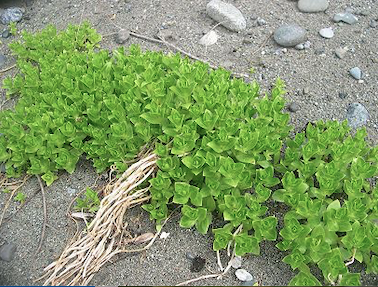
Seabeach sandwort [Mary Jo Adams]
Seabeach sandwort Honkenya peploides
Honkenya peploides forms low mounds about 10 inches high on the backshores of sandy beaches.  It has small inconspicuous white or greenish white flowers that bloom May to September.  This plant belongs to the pink family.  It is native in the Pacific Northwest and its range extends from northern Oregon to Alaska, out the Aleutian chain, and along the Arctic shoreline to Greenland and Iceland.  Another common name for it is sea purslane. (Mary Jo Adams/Sound Waters Stewards)

All five Wet’suwet’en clans meet to discuss tentative land titles agreement
All five Wet’suwet’en clans have met to discuss a two-page tentative agreement struck between hereditary chiefs and the government. The first meeting — among the Laksilyu clan — was held on Tuesday in Witset and the final meeting was held Sunday by the Tsayu clan. The Gilseyhu clan held its meeting in the Office of the Wet’suwet’en in Smithers, while the others were held in the Centennial Hall in Witset. At those meetings clan members were shown and discussed a two-page agreement on self government and land title that was struck on March 1 after three days of meetings between some Wet’suwet’en hereditary chiefs and the B.C. and federal government. The meeting was held after weeks of escalating protests and blockades Canada-wide after police arrested some Wet’suwet’en members preventing Coastal GasLink contractors from accessing a work site on the Morice Forest Service Road, southwest of Houston in Northern B.C. David Carrigg reports. (Vancouver Sun)

Train that derailed near B.C. school was carrying extremely flammable propane: TSB
A CN derailment that forced a school evacuation in B.C. last week included seven train cars carrying liquefied petroleum gas, an extremely flammable, dangerous good, according to the Transportation Safety Board. The TSB had two investigators at the derailment site on the CN main line, about 44 km east of Prince George in Giscome. CN did not reply to repeated requests to identify the contents of all the cars. Transport Canada's website says liquefied petroleum gas, also known as LPG or propane, is extremely flammable, easily ignited by heat and able to form explosive mixtures when mixed with air. Betsy Trumpener reports. (CBC)

Herring moratorium supporters come out in droves for protest
One of the organizers of a flotilla protest against the Salish Sea herring fishery is calling it a success. Locky MacLean from Conservancy Hornby Island said around midday yesterday, supporters began congregating on the beaches of Denman Island and Hornby Island, specifically at Ford’s Cove and Bill Mee Park. MacLean said the turnout exceeded expectations. “I would say there were about 500 people,” he said. Troy Landreville reports. (My Powell River Now)


Now, your tug weather--

West Entrance U.S. Waters Strait Of Juan De Fuca-  300 AM PDT Tue Mar 10 2020   
SMALL CRAFT ADVISORY IN EFFECT THROUGH WEDNESDAY AFTERNOON
  
TODAY
 SE wind 10 to 15 kt...becoming SW and rising to 15 to 25  kt. Wind waves 3 to 5 ft. W swell 4 ft at 11 seconds. Rain likely  in the morning then rain in the afternoon. 
TONIGHT
 W wind 15 to 25 kt. Wind waves 2 to 4 ft. W swell 7 ft  at 10 seconds. Rain in the evening then a chance of rain after  midnight.


--
"Salish Sea News & Weather" is compiled as a community service by Mike Sato. To subscribe, send your name and email to msato (@) salishseacom.com. Your email information is never shared and you can unsubscribe at any time.

Salish Sea News: Communicate, Educate, Advocate

Follow on Twitter. 

Salish Sea Communications: Truth Well Told
Monday, March 9, 2020

3/9 Killdeer, oil prices, B'ham waterfront, Kimberly-Clark cleanup, salmon harvest, BC LNG protest, CN derail, pipeline safety, warm oceans, rural trade woes, UBC pollution appeal, butterfly rangers, virus commentary

Killdeer [All About Birds]
Killdeer Charadrius vociferus
Look for Killdeer on open ground with low vegetation (or no vegetation at all), including lawns, golf courses, driveways, parking lots, and gravel-covered roofs, as well as pastures, fields, sandbars and mudflats. This species is one of the least water-associated of all shorebirds. Killdeer spend their time walking along the ground or running ahead a few steps, stopping to look around, and running on again. When disturbed they break into flight and circle overhead, calling repeatedly. Their flight is rapid, with stiff, intermittent wingbeats. (All About Birds)


Oil prices take biggest plunge in decades amid coronavirus uncertainty, price-war fear
Oil prices dramatically dropped as markets opened in Asia on Monday, down more than 25 per cent after a 10 per cent drop on Friday. West Texas Intermediate crude fell $9 US to $32 and international benchmark Brent fell $11 to $34...Martin Pelletier, a portfolio manager with Trivest Wealth Council in Calgary, said this is a "nuclear-sized event" for an already-hurting Alberta, and if not contained, the economic malaise could spread to the rest of the country. "This could be the knock-out punch for Alberta, unfortunately," Pelletier said, adding that some companies might not survive the hit. Sarah Rieger reports. (Canadian Press) See also: Stock futures sink deep into red as oil prices plummet and coronavirus fears spread  Will Englund reports. (Washington Post)

Downtown Bellingham waterfront site sprouts new signs of life
After almost 20 years of frustration and stagnation, the first tender shoots of redevelopment have appeared amid the post-industrial desolation that Georgia-Pacific Corp. left behind on Bellingham’s downtown waterfront. John Stark reports. Melissa Marteny photos. (Salish Current)

Environmental cleanup beginning at waterfront mill property
Crews are about to kick off the cleanup of a prime-but-polluted piece of shoreline real estate. By March 15, contractors of Dallas-based Kimberly-Clark will be at work on the roughly 60-acre waterfront site that once housed a paper and pulp mill, Port of Everett officials said last week. The port, which took ownership of the site on Nov. 1, plans to build a cargo terminal there. But first, crews must decommission shoreline pipes, remove an estimated 12,000 tons of contaminated soil, and haul away 180,000 to 200,000 tons of crushed material left over from the mill’s demolition after it closed in 2012. Rachel Riley reports. (Everett Herald)

Harvest managers setting this year’s salmon seasons struggle to find ways to help orcas
As state, tribal and federal salmon managers work together to establish this year’s fishing seasons, they have not forgotten about the needs of Puget Sound’s endangered killer whales. In fact, new documents related to the southern resident orcas describe an investigation looking to find ways to reduce fisheries at certain times and locations that might get the whales more food. And yet it appears that nobody has figured out a way to help the whales by reducing salmon fishing. Annual negotiations to establish seasons and quotas for commercial, tribal and sport fishing are now underway in what is called North of Falcon process, so named because it involves fisheries north of Cape Falcon in Oregon. Chris Dunagan reports. (Puget Sound Institute)

Poll suggests public supports Coastal GasLink project, has lost patience with blockades
British Columbians mostly support construction of the $6.6 billion Coastal GasLink pipeline and do not believe roadblocks, rail blockades and other disruptions are acceptable ways to show opposition to it, according to a poll. The online poll by Leger, conducted for Postmedia, suggests that 57 per cent of British Columbians strongly or somewhat support construction of the 670 km natural gas pipeline between Dawson Creek and LNG Canada’s liquefied natural gas plant at Kitimat. Derrick Penner reports. (Vancouver Sun)

27 train cars derailed, petroleum coke spilled in creek east of Prince George, CN says
A freight-train derailment on Thursday near Prince George, B.C., that sparked the evacuation of an elementary school was larger than Canadian National Railway first reported. On Friday, the rail company said 27 cars went off the tracks, not 20, as first reported. On Thursday, CN said there were no leaks or spills. But Friday morning, CN said a "small amount" of petroleum coke spilled into a nearby creek. The creek is part of the Fraser River watershed. Petroleum coke is a "non-hazardous byproduct" of the refining process, the company says. Betsy Trumpener reports. (CBC)

Canada has enough pipelines to circle the globe several times. Can they ever be incident-free?
Energy companies should invest more of their profits in safety inspections and replacing aging infrastructure, says the former chair of the U.S. National Transportation Safety Board. Jim Hall spoke to CBC after the Transportation Safety Board of Canada revealed that a pipeline explosion near Prince George, B.C., in 2018 was the result of undetected stress cracks on an aging section of pipeline owned by Enbridge. Andrew Kurjata and Betsy Trumpener report. (CBC)

Warming ocean conditions fuel viruses among species in the Salish Sea
As officials struggle to track and contain the outbreak of the novel coronavirus known as COVID-19, ecologists say widespread impacts from viruses and other pathogens are also a growing threat to the species of the Salish Sea ecosystem. Jeff Rice reports. (Puget Sound Institute)

In rural Washington, coronavirus outbreak takes a big bite out of pulp and shellfish exports to China
The Cosmo Specialty Fibers mill runs 24 hours a day to turn Olympic Peninsula wood chips and logs into pulp for rayon fiber manufacturers. For seven weeks, this output has been piling up in warehouses due to an epic market implosion in China, where major customers have been largely unable to operate amid efforts to combat the novel coronavirus. This is a big financial setback for one of the largest employers in Grays Harbor County. Mill owners have pared back spending, and hope to avoid layoffs in a nearly 200-person workforce. Hal Bernton reports. (Seattle Times)

UBC quietly appeals conviction for dumping fish-killing ammonia in Fraser River tributary
The University of British Columbia, which takes pride in promoting environmental responsibility and sustainability, is appealing a conviction for dumping fish-killing ammonia into a tributary of the Fraser River and, if the conviction is upheld, UBC will also appeal the $1.2 million fine that was designated for habitat restoration, arguing for a much-reduced fine. Judith Lavoie reports. (The Narwhal)

Metro Vancouver butterfly rangers set to plant and protect 
The David Suzuki Foundation would like you to plan for the little pollinators when you plant your gardens this spring. They're encouraging people to use plants such as asters and red columbine in order to aid butterflies and bees gather pollen. Winnie Hwo says their annual butterfly ranger campaign helps spread this message and enlists citizens of the Lower Mainland to take pictures of species they see and send them in for counting. Theresa Lalonde reports. (CBC)

Commentary: In the age of coronavirus, our nation needs a responsible leader who trusts scientists 
Michael Riordan writes: "As the numbers of local coronavirus cases and deaths grow inexorably, Seattle-area citizens are paying the awful price of President Donald Trump’s disdain for science. Our sprawling metropolitan area has become the U.S. epicenter of this new disease, which could have been better contained had his administration not turned its back on prudent prevention and control efforts...." (Seattle Times)

Commentary: Coronavirus exposes urgent need to fix gaps in Washington state’s safety net
Washington Sen. Patty Murray stood in a hearing room at the nation’s Capitol on Tuesday and hit the bullseye. Speaking of the coronavirus that made its first US landfall in her home state, Murray said, “Situations like this remind us we are all a community in a very real sense, and we all have a stake in one another’s wellbeing.” Indeed, we do. When it comes to eradicating human pathogens, from measles to smallpox, intervention and prevention are most effective when applied to all people, including those at society’s margins. (News Tribune of Tacoma)


Now, your tug weather--
West Entrance U.S. Waters Strait Of Juan De Fuca-  239 AM PDT Mon Mar 9 2020   
TODAY
 SE wind 5 to 15 kt. Wind waves 1 to 2 ft. W swell 4 ft  at 14 seconds. 
TONIGHT
 S wind to 10 kt. Wind waves 1 ft. W swell 5 ft at  12 seconds.


--
"Salish Sea News & Weather" is compiled as a community service by Mike Sato. To subscribe, send your name and email to msato (@) salishseacom.com. Your email information is never shared and you can unsubscribe at any time.

Salish Sea News: Communicate, Educate, Advocate

Follow on Twitter. 

Salish Sea Communications: Truth Well Told

Friday, March 6, 2020

3/6 Dungeness crabs, Whatcom Museum, Swinomish win, rail disaster probes, Anacortes refinery sale, feeding trees

Dungeness crabs [Alaska Fish & Game]
West Coast Dungeness Crab Stable or Increasing Even With Intensive Harvest, Research Shows
The West Coast Dungeness crab fishery doesn’t just support the most valuable annual harvest of seafood on the West Coast. It’s a fishery that just keeps on giving. Fishermen from California to Washington caught almost all the available legal-size male Dungeness crab each year in the last few decades. However, the crab population has either remained stable or continued to increase, according to the first thorough population estimate of the West Coast Dungeness stocks. (NOAA Fisheries)


Whatcom Museum opens heritage exhibits to indigenous people; part of 'bigger conversation'
New exhibits and a new perspective on access at the Whatcom Museum of History and Art have become threads in a national conversation about the relationship between museums and indigenous people. For the duration of “Tribal Canoe Journeys,” which features photographs of the 2019 Paddle to Lummi, the museum will waive entrance fees for indigenous people. The exhibit features photographs from the tribal nonprofit Children of the Setting Sun Productions. Kimberly Cauvel reports. (Salish Current)

Appeals court sides with Swinomish in BNSF suit
A federal appeals court sided Wednesday with the Swinomish Indian Tribal Community in its lawsuit against BNSF Railway. The 9th U.S. Circuit Court of Appeals affirmed a lower court ruling that upheld the tribe's right to sue to enforce an agreement on train traffic on tribal land. With this issue resolved, the case is being sent back to federal district court, the ruling states. Brandon Stone reports. (Skagit Valley Herald)

Police not probing recent rail disasters, crude oil derailments, deaths for possible negligence
Public police forces are choosing not to investigate major accidents at CN and Canadian Pacific Railway, including recent crude oil train crashes and deadly derailments, a CBC News investigation into Canada's rail system has found. Instead, the RCMP, Ontario Provincial Police and other forces routinely defer to little-known federal railway police run by CP and CN, leaving the companies to investigate themselves with no outside police looking into potential criminal negligence. Dave Seglins and Joseph Loiero report. (CBC)

Shell seeking buyer for Anacortes refinery
Shell Puget Sound Refinery on March Point is for sale, the refinery’s parent company announced Thursday. Shell Oil Products U.S., a subsidiary of Royal Dutch Shell, is seeking a buyer for two U.S. refineries — the Anacortes refinery and a refinery in Mobile, Alabama, according to a Thursday news release. The news release states that the process may take months and may not result in a sale. The company stated it may elect to take the refineries off the market at any time. Jacqueline Allison reports. (Skagit Valley Herald)

How Seashells Feed Trees
In summer 2018, Kieran Cox stood on the coast of Calvert Island, 420 kilometers northwest of Vancouver, British Columbia, transfixed by crows dropping clams on rocks to get to the fleshy meal inside. For the University of Victoria PhD candidate, it was a “lightbulb moment.” The crows were not just getting a snack but were also transporting the nutrients in the shellfish from ocean to land, transferring calcium, phosphorus, vitamin B12, trace minerals, and more to terrestrial plants and animals. Christopher Pollen reports. (Hakai Magazine)


Now, your weekend tug weather--

West Entrance U.S. Waters Strait Of Juan De Fuca-  214 AM PST Fri Mar 6 2020   
SMALL CRAFT ADVISORY IN EFFECT THROUGH THIS AFTERNOON
  
TODAY
 SE wind to 10 kt. Wind waves 1 ft or less. W swell 11 ft  at 13 seconds. A slight chance of showers. 
TONIGHT
 SE wind to 10 kt. Wind waves 1 ft or less. W swell  8 ft at 12 seconds. A chance of showers. 
SAT
 Light wind becoming W to 10 kt in the afternoon. Wind  waves 1 ft or less. W swell 6 ft at 12 seconds. A chance of  showers in the morning then showers likely and a slight chance of  tstms in the afternoon. 
SAT NIGHT
 W wind 5 to 15 kt becoming to 10 kt after midnight.  Wind waves 2 ft or less. W swell 5 ft at 11 seconds. 
SUN
 Light wind. Wind waves less than 1 ft. W swell 4 ft at  10 seconds.


--
"Salish Sea News & Weather" is compiled as a community service by Mike Sato. To subscribe, send your name and email to msato (@) salishseacom.com. Your email information is never shared and you can unsubscribe at any time.

Salish Sea News: Communicate, Educate, Advocate

Follow on Twitter. 

Salish Sea Communications: Truth Well Told

Thursday, March 5, 2020

3/5 Heather, TMX, Skagit salmon, kids climate, Trump's 'secret science' rule, Mussel Watch, Stephanie Buffum

Common heather
Common heather Calluna vulgaris
Common heather (ling or simply heather) is the sole species in the genus Calluna in the flowering plant family Ericaceae. It is a low-growing perennial shrub growing to 7.9 to 19.7 inches tall, or rarely to 39 inches and taller, and is found widely in Europe and Asia Minor on acidic soils in open sunny situations and in moderate shade. (Wikipedia)

Supreme Court of Canada will not hear B.C. groups' challenges against Trans Mountain pipeline expansion
The Supreme Court of Canada has declined to hear five B.C.-based challenges against the Trans Mountain pipeline expansion project. The groups fighting the project had argued a previous judicial review of the pipeline's second federal approval was unfairly denied by a single judge from the Federal Court of Appeal. B.C. Nature, the Raincoast Conservation Foundation, the Squamish and Tsleil-Waututh First Nations and a number of youth applied to the country's top court for leave to appeal that dismissal. (CBC)

Fishery forecasts dismal for Skagit River
As federal, state and tribal fisheries managers prepare to negotiate fishing seasons for 2020-21, the outlook on the number of fish returning is not good...For the Skagit River, coho, chum and sockeye salmon are forecast to return at less than 75% of the 10-year average. Chinook salmon are forecast to return at numbers between 75% and 125% of the 10-year average. Kimberly Cauvel reports. (SKagit Valley Herald)

Young Climate Plaintiffs Seek Second Chance in Federal Court
The 21 young plaintiffs who lost their ambitious climate lawsuit against the federal government are seeking another shot to make their case in court, a move that could push the dispute toward risky legal territory. The kids and young adults in Juliana v. United States on Monday asked the U.S. Court of Appeals for the Ninth Circuit to rehear the case en banc, before 11 active judges on the court. A smaller panel of three judges ruled against the plaintiffs in January. Ellen Gilmer reports. (Bloomberg)

EPA revamp of 'secret science' rule will keep limiting research, scientists say
The Environmental Protection Agency (EPA) walked back a component of one its most controversial proposals Thursday, weakening an effort that would have restricted the agency from considering scientific studies that don’t make their underlying data public. But the tweaks are not garnering support from the scientific community, as it expands the 2018 proposal in other ways. Rebecca Beitsch reports. (The Hill)

Mussels fetched from Kitsap waters give insight into contamination
At a lab in Olympia, mussels from Kitsap County waters are being broken apart, blended like a smoothie, and sent for testing to determine what toxins and contaminants lurk. Mussel Watch is a program run by the Washington Department of Fish and Wildlife throughout Puget Sound that tests the tissue of mussels for contaminants in the water. The data is used to look at trends and to find areas where the contamination needs to be addressed. Results from the last cycle — in 2017 — showed that Puget Sound has particles from fuel and laundry detergent, and 100% of sites tested showed a presence of antibiotics used for livestock. All sites also tested positive for antidepressant medication, said Mariko Langness, WDFW fish and wildlife biologist. Jessie Darland reports. (Kitsap Sun)

Leadership change at Friends of the San Juans
After 19 years as Executive Director of Friends of the San Juans, Stephanie Buffum submitted her letter of resignation and retired as of March 1, 2020. (Orcas Issues)


Now, your tug weather--

West Entrance U.S. Waters Strait Of Juan De Fuca-  238 AM PST Thu Mar 5 2020   
SMALL CRAFT ADVISORY IN EFFECT UNTIL 10 AM PST THIS MORNING
  
TODAY
 SE wind 15 to 25 kt becoming W in the afternoon. Wind  waves 2 to 4 ft. W swell 8 ft at 13 seconds building to 10 ft at  12 seconds in the afternoon. A chance of rain in the morning then  rain in the afternoon. 
TONIGHT
 SW wind to 10 kt becoming W after midnight. Wind waves  1 ft or less. W swell 12 ft at 13 seconds. Rain in the evening  then a slight chance of rain after midnight.


--
"Salish Sea News & Weather" is compiled as a community service by Mike Sato. To subscribe, send your name and email to msato (@) salishseacom.com. Your email information is never shared and you can unsubscribe at any time.

Salish Sea News: Communicate, Educate, Advocate

Follow on Twitter. 

Salish Sea Communications: Truth Well Told

Wednesday, March 4, 2020

3/4 Octopus, BC LNG 'patience,' BC fossil fuels, salmon forecast, construction for fish, bad tuna, Port Alberni aquarium, Chehalis River dam

Pacific octopus [Monterey Bay Aquarium]
The many brains of an octopus
An octopus has two-thirds of its brain cells in its suckers — suction cups along its arms that help in catching prey and moving around. This enables the octopus to process information locally and allows the arms to work independent of the brain. Researchers at the Gire Lab at the UW are attempting to understand the unique process of decision making in octopuses. Each sucker behaves as if it has its own brain. Akanksha Mishra reports. (UW Daily)

Trudeau urges patience as Wet’suwet’en mull over land and title deal
Prime Minister Justin Trudeau says he knows people are impatient for a resolution to tensions involving a disputed natural gas pipeline in northern British Columbia, but time is needed to respect the traditions of the Wet’suwet’en people. Speaking to reporters in Halifax this morning, Trudeau acknowledged the opposition of some Wet’suwet’en leaders to the Coastal GasLink pipeline has led to difficult times for many Canadians over the past few weeks. He said his government has been focused on trying to find a solution, but added that current tensions stem from centuries of marginalizing Indigenous Peoples in Canada. (National Post)

B.C. politicians must focus more on phasing out fossil fuels, report says
Politicians in British Columbia aren't focused enough on phasing out fossil fuel industries, a new report says. The report, authored by the left-leaning Canadian Centre for Policy Alternatives, said the province must move away from fossil fuel industries by mid-century in order to meet its climate targets, but adds that the B.C. government is ill prepared to transition to a green economy. (CBC)

Salmon forecasts released as salmon season-setting process gets underway for 2020
Fishery managers say the coming year may be another tough one for anglers in Washington, with low salmon returns expected again in 2020. The 2020 forecasts for Chinook, coho, sockeye and chum salmon — developed by the Washington Department of Fish and Wildlife and treaty Indian tribes — were released during a public meeting in Olympia. The forecast meeting marks the starting point for developing this year’s salmon-fishing seasons in Puget Sound, the Columbia River, and Washington coastal areas, part of the annual “North of Falcon” process that sets salmon fisheries. A series of public meetings is scheduled through early April to develop tentative fishing seasons for the upcoming year. (Associated Press)

WA considers requiring new construction projects to improve the environment
In a move promoted by environmentalists and others as key to staving off the extinction of Puget Sound orcas — but opposed by the building industry — Washington may soon take a first, small step toward requiring that development benefit the environment. The budget proposed by the Washington House calls for planners to begin preparing to replace the state’s requirement that construction cause “no net loss” to habitat with a higher standard backed by environmental advocates — “net ecological gain.” It appears Washington would be the first state in the nation to do so. Levi Pulkkinen reports. (InvestigateWest)

Tuna sold in B.C. recalled due to high levels of histamine
More tuna products sold throughout British Columbia have been recalled after an investigation by the Canadian Food Inspection Agency found high levels of histamine. The expanded list includes frozen and previously frozen ahi tuna steaks that were sold in various B.C. Choices Market and IGA stores, and Save On Foods in B.C. Alberta, Manitoba, Saskatchewan and Yukon. (CBC)

Vancouver Island aquarium fights to stay open
Employees at Port Alberni's only aquarium say the space is vital to providing education in the community, in the midst of climate change. But last week the Alberni Aquarium and Stewardship Centre's board of directors said the centre just wasn't bringing in enough revenue to cover expenses, and now the space is likely to close at the end of March. Adam van der Zwan reports. (CBC)

Proposed new dam on Chehalis to address chronic flooding raises many questions
The Chehalis River has flooded 18 times in the past 20 years, sometimes submerging Interstate 5 near Olympia. The local Flood Control Zone District is proposing a new dam to prevent extreme high water. A draft environmental impact statement is now out for public comment.  The new dam would only trap water when the river reaches a certain volume. This is what’s known as a “run of the river” dam; under normal conditions, it would let the Chehalis run. It's designed with fish passage through underground tunnels and there are mechanisms for a gradual release from the reservoir after any damming. But the structure would require clearing forest land along the river — and it would be massive. Bellamy Pailthorp reports. (KNKX)


Now, your tug weather--

West Entrance U.S. Waters Strait Of Juan De Fuca-  136 AM PST Wed Mar 4 2020   
SMALL CRAFT ADVISORY IN EFFECT THROUGH THIS AFTERNOON
  
TODAY
 W wind 15 to 25 kt becoming NW to 10 kt in the  afternoon. Wind waves 2 to 4 ft subsiding to 1 ft or less. W  swell 13 ft at 14 seconds subsiding to 11 ft at 14 seconds. 
TONIGHT
 SE wind to 10 kt rising to 5 to 15 kt after midnight.  Wind waves 2 ft or less. W swell 9 ft at 13 seconds. A slight  chance of rain in the evening then a chance of rain after  midnight.


--
"Salish Sea News & Weather" is compiled as a community service by Mike Sato. To subscribe, send your name and email to msato (@) salishseacom.com. Your email information is never shared and you can unsubscribe at any time.

Salish Sea News: Communicate, Educate, Advocate

Follow on Twitter. 

Salish Sea Communications: Truth Well Told

Tuesday, March 3, 2020

3/3 Primrose, Cooke net-pen, low-carbon fuel, BC LNG, Arctic sea ice, BC herring, Sound water quality, geoduck sales

Primrose
Primrose Primula polyantha
Primrose flowers bloom in early spring, offering a variety of form, size, and color.They are suitable for use in garden beds and borders as well as in containers or for naturalizing areas of the lawn. In fact, when given the proper growing conditions, these vigorous plants will multiply each year, adding stunning colors to the landscape. (Gardening Know-How)

Court upholds termination of Cooke Aquaculture net-pen lease in Port Angeles
Termination of the lease for a fish-farming operation in the harbor at Port Angeles has been upheld in Thurston County Superior Court. Cooke Aquaculture Pacific said it would appeal the ruling. Kurt Grinnell, a member of the Jamestown S’Klallam Tribal Council and CEO of Jamestown Seafood, said he’s hopeful something can be worked out to keep afloat a partnership with Cooke to farm black cod and steelhead at the site. The tribe has no interest in using any of Cooke’s farms in other locations, Grinnell said, so the Port Angeles lease is a make or break for the joint venture. Lynda Mapes reports. (Seattle Times)

Gov. Jay Inslee's low-carbon fuel standard faces tough road ahead in Washington state
Gov. Jay Inslee’s campaign to clamp down on greenhouse gas emissions from the state’s transportation fuels, a high-profile goal throughout his two terms in office, faces a difficult road as the Washington state Legislature heads into the final two weeks of its session. Legislation passed by the House of Representatives calls for a 20% reduction of the carbon intensity of these fuels by 2035 over 2017. The bill is being championed by a coalition of Inslee allies that includes many statehouse Democrats, environmental groups, health care workers, the Port of Seattle and some local governments...But for a second year in row, the House legislation risks dying in the state Senate Transportation Committee, where the chairman, state Sen. Steve Hobbs, D-Lake Stevens, has been hostile to this clean-fuels standard. Hal Bernton reports. (Seattle Times)

Coastal GasLink pipeline construction resumes with draft accord set between chiefs, ministers
Work has resumed on a natural gas pipeline in British Columbia at the centre of protests that have disrupted both rail and road traffic across the country, but questions remain about how opponents to the project will react to workers and the RCMP re-entering Wet'suwet'en territory. The RCMP, which is under contract provincially in B.C., has resumed patrolling the area and is once again monitoring an access road that leads to the work site for the Coastal GasLink natural gas pipeline. (Canadian Press)

Draft agreement between governments, Wet'suwet'en hereditary chiefs offers hope and uncertainty
No details of accord made public, but it's known that there's still no agreement on Coastal GasLink pipeline Yvette Brend reports. (CBC) Horgan maintains Wet’suwet’en deal marks no change for Coastal GasLink  
Premier John Horgan remained adamant on Monday that the agreement between the province, federal government and Wet’suwet’en First Nation over Aboriginal rights and title won’t affect the $6.6-billion Coastal GasLink project. Derrick Penner reports. (Vancouver Sum)

Arctic sea ice: Summers could be ice-free in as few as 15 years
Climate change is taking its toll on one of the world's coldest places. A study suggests that the Arctic "may be essentially ice-free during summer within 15 years." The study used statistical models to predict the future amount of Arctic ice, which suggested that the Arctic could be ice-free in the summer during the decade of the 2030s – most likely in the year 2034. Doyle Rice reports. (USA Today)

Wildlife advocacy groups upset herring fishery forging ahead
Wildlife advocates are speaking out, with this year’s Salish Sea herring fishery on the horizon. They say coastal British Columbia’s herring stocks are collapsing and the fishery is only making matters worse. Advocacy groups including Conservancy Hornby Island are calling for a moratorium on the province’s last remaining herring fishery. It claims that with less than 56,000 tonnes of herring, it’s the lowest numbers since the industrial collapse of the herring fishery in the 1950s, adding that the Department of  permits a quota “unchanged since 1983.” Troy Landreville reports. (My Campbell River Now)

McMorris Rodgers requests EPA look into Puget Sound water pollution in Washington
The Environmental Protection Agency (EPA) should look into water pollution occurring in her home state of Washington to help recover endangered salmon and orcas, said U.S. Rep. Cathy McMorris Rodgers (R-WA). EPA Administrator Andrew Wheeler specifically should consider the lack of action under Washington Gov. Jay Inslee, a Democrat, regarding Puget Sound, McMorris Rodgers said during a Feb. 27 hearing on the fiscal year 2020 EPA budget held by the U.S. Energy and Commerce Subcommittee on the Environment and Climate Change. “For too long, Governor Inslee and others have turned a blind eye to the issues in their own backyard, and instead pointed a finger to eastern Washington as the source of all their problems and how we save salmon,” Rep. McMorris Rodgers told Wheeler during the hearing. “But yet nearly every week we have to defend our dams from those who refuse to look at the science and the facts.” (Ripon Advance Mews Service)

Coronavirus hits a WA geoduck industry already struggling with tariffs
In the muddy tideflats of South Puget Sound, geoduck farmer Jim Gibbons was gearing up for a banner month in January. Each day, up to 6,000 pounds of orders were pouring in to his company, Seattle Shellfish. Geoducks make up 85 percent of the company’s revenue, and most of those orders come from Asia, mostly China, where the uniquely Salish Sea shellfish is a popular delicacy for Lunar New Year celebrations. Until Thursday, Jan. 23, the day before the new year. “That was the day Wuhan shut down,” Gibbons told Crosscut via phone. “And we haven’t sold any to China since then.” Gregory Scruggs reports. (Crosscut)


Now, your tug weather--

West Entrance U.S. Waters Strait Of Juan De Fuca-  257 AM PST Tue Mar 3 2020   
SMALL CRAFT ADVISORY IN EFFECT THROUGH WEDNESDAY MORNING
  
TODAY
 SW wind 15 to 25 kt. Wind waves 2 to 4 ft. W swell 8 ft  at 14 seconds. Rain likely in the morning then rain in the  afternoon. 
TONIGHT
 W wind 15 to 25 kt. Wind waves 2 to 4 ft. W swell 9 ft  at 14 seconds. Rain in the evening then a chance of rain after  midnight.


--
"Salish Sea News & Weather" is compiled as a community service by Mike Sato. To subscribe, send your name and email to msato (@) salishseacom.com. Your email information is never shared and you can unsubscribe at any time.

Salish Sea News: Communicate, Educate, Advocate

Follow on Twitter. 

Salish Sea Communications: Truth Well Told

Monday, March 2, 2020

3/2 Crows, dams, BC LNG, critter AI

Crow funeral [Tony Angell]
Happy 15th Birthday, BirdNote!
Happy birthday, BirdNote. And what a better way to celebrate than sharing BirdNote's story about crows: 'Tony Angell, along with Professor John Marzluff of the University of Washington, wrote the book, Gifts of the Crow: How Perception, Emotion, and Thought Allow Smart Birds to Behave Like Humans. Tony says, "A crow 'funeral' is where the deceased bird is surrounded by members of the same species, in significant numbers." Crows descend from the trees, and they walk around the bird on the ground. And then they fly off. It's very likely that the crows are learning from this experience. Is there danger here? What does the death of this particular crow mean to the social structure of that community of crows? It seems to be a little more complicated than just paying homage.' Follow BirdNote and check out Tony Angell's exhibit at Seattle's Foster/White Gallery March 5-21.

Feds reject removal of 4 US Northwest dams in key report
Years and millions of dollars in the making, a draft federal report on hydroelectric dam operations in the Columbia Basin will not settle the decadeslong fight over saving imperiled salmon in the Columbia and Snake rivers. Federal agencies found that taking out the dams would “provide a long-term benefit to species that spawn or rear in the mainstem Snake River habitats,” but also would have adverse impacts, including increased power costs, a rise in greenhouse gases and reduced reliability of the electric grid. The report rejects the idea of removing the dams to save endangered or threatened salmon. The removal of the dams has been a rallying cry for advocates of salmon and the endangered southern resident orcas, which rely on Columbia and Snake chinook to survive. But supporters of the dams praised the draft environmental impact statement (EIS) as an important affirmation of their value in a region increasingly placing a premium on renewable electricity. Hal Bernton reports. (Seattle Times)

Wet'suwet'en chiefs, ministers reach proposed agreement in pipeline dispute
A Wet'suwet'en hereditary chief and senior government ministers say they have reached a proposed arrangement to acknowledge land title rights established more than 20 years ago in a Supreme Court decision. The parties agree the proposal is an important step in discussions related to a natural gas pipeline dispute that has prompted solidarity protests across Canada in recent weeks. But the parties still disagree on how to move forward with the controversial pipeline. (CBC) There's no 'quick fix' in B.C. pipeline talks, say government liaison Hina Alam reports. (Canadian Press) 'Without a doubt': B.C. premier says Wet'sewet'en conflict his biggest challenge yet  With the province deeply divided over the Wet'suwet'en conflict, the events of the past few weeks have taken a toll politically and personally on B.C.'s premier. Tanya Fletcher reports. (CBC)

How a Portland nonprofit is using artificial intelligence to help save whales, giraffes, zebras
To the untrained eye, zebras in Kenya probably all look alike. But each animal’s black and white markings are like a fingerprint, distinct — and invaluable for scientists who need to track the animals and information about them, including their births, deaths, health and migration patterns. Traditionally, getting this kind of information has been an invasive and labor-intensive process. But breakthroughs in artificial intelligence (AI) and crowdsourcing of photos of individual animals are beginning to change the conservation game. Aimee Rawlins reports.(Seattle Times)


Now, your tug weather--
West Entrance U.S. Waters Strait Of Juan De Fuca-  257 AM PST Mon Mar 2 2020   TODAY  SW wind 15 to 25 kt easing to 10 to 20 kt. Wind waves 1  to 4 ft. W swell 6 ft at 13 seconds building to 8 ft at 12  seconds in the afternoon. A chance of rain in the morning then  rain likely in the afternoon. 
TONIGHT
 W wind 10 to 20 kt becoming 5 to 15 kt after midnight.  Wind waves 1 to 3 ft. W swell 8 ft at 11 seconds. Rain in the  evening then a chance of rain after midnight.


--
"Salish Sea News & Weather" is compiled as a community service by Mike Sato. To subscribe, send your name and email to msato (@) salishseacom.com. Your email information is never shared and you can unsubscribe at any time.

Salish Sea News: Communicate, Educate, Advocate

Follow on Twitter. 

Salish Sea Communications: Truth Well Told