Thursday, September 29, 2022

9/29 Blueberry, sea weed contaminants, salmon recovery funding, freak heat wave, candidate antisemitism

Oval-leaved Blueberry [Native Plants PNW]

Oval-leaved Blueberry Vaccinium ovalifolium
There are about 450 species of Vaccinium worldwide, about 40 in North America with about 15 in the Pacific Northwest.  The genus Vaccinium includes Blueberries, Huckleberries, Cranberries, Lingonberries, Whortleberries, Bilberries and Cowberries. This species is found from southern Alaska to Oregon in the west, including the Idaho Panhandle and Montana. In the eastern United States it is found only in Upper Michigan. It is found in all the Canadian provinces and territories, excluding Saskatchewan, Manitoba and the Nunavut Territory.  It is also found stretching across much of the Pacific Rim from the Aleutians to Japan and parts of the eastern mainland of Asia. Natives ate the tart, flavorful berries fresh, dried, or mixed with oil or oolichan grease.  The berries also make excellent jelly or wine. (Native Plants PNW)

Study raises concerns about contaminants in edible seaweeds
A new study https://journals.plos.org/plosone/article?id=10.1371/journal.pone.0269269 just published by researchers at Western Washington University (WWU) reports concentrations of up to 162 chemical contaminants in three species of edible seaweeds gathered in the Salish Sea. (The Fish Site)

State Board awards nearly $76 Million in grants to fund salmon recovery projects
On Sept. 26, the Washington State Salmon Recovery Funding Board announced the award of nearly $76 million in grants across the state to help ensure the survival of salmon in Washington. The grants that were funded went to 138 projects in 30 of the state’s 39 counties. The grants will pay for work to restore salmon habitat, including repairing degraded habitat in rivers, removing barriers blocking salmon migration and conserving pristine habitat. Cameron Sheppard reports. (Auburn Reporter)

Pacific Northwest heat wave was a freak, 10,000-year event, study finds
A new study finds the Pacific Northwest’s extreme heat wave last summer was a freak event that should only happen once in 10,000 years and it was even hotter because of climate change. Monica Samayoa reports. (OPB)

WA GOP candidate acknowledges social media post is antisemitic
A GOP candidate for the Washington Legislature has acknowledged that a post he put on social media in 2020 is antisemitic. Dan Johnson, of Laurel, who is running to represent part of Northwest Washington in the House, posted a meme on Facebook that showed a yellow Star of David with the words, “A new badge has been created which will allow you to go back to work, to travel in your state, to fly, catch a train or bus and to buy and sell,” The Bellingham Herald reported. (Associated Press)


Now, your tug weather--
West Entrance U.S. Waters Strait Of Juan De Fuca-  247 AM PDT Thu Sep 29 2022   
TODAY
 W wind to 10 kt becoming 5 to 15 kt in the afternoon.  Wind waves 2 ft or less. SW swell 5 ft at 9 seconds. TONIGHT  W wind 5 to 15 kt becoming NW to 10 kt after midnight.  Wind waves 2 ft or less. SW swell 3 ft at 9 seconds.


--
"Salish Sea News & Weather" is compiled as a community service by Mike Sato. To subscribe, send your name and email to mikesato772 (@) gmail.com. Your email information is never shared and you can unsubscribe at any time.

Salish Sea News: Communicate, Educate, Advocate

Follow on Twitter. 

Salish Sea Communications: Truth Well Told


Wednesday, September 28, 2022

9/28 Cumacea, SRKW census, Nuchatlaht land claim, urban green spaces, plastics, youth on dams, Pier 58, tug sinking, Englishman River, shrinking deltas

Cumacea [Hans Hillewaert/WikiCommons]

 
Cumacea
Cumacea is an order of small marine crustaceans of the superorder Peracarida, occasionally called hooded shrimp or comma shrimp. Their unique appearance and uniform body plan makes them easy to distinguish from other crustaceans. They live in soft-bottoms such as mud and sand, mostly in the marine environment. Wikipedia

Killer whale census shows another down year, with three deaths and two births
Three deaths and two births. Over the past year, the endangered Southern Resident killer whale population has declined by a total of one, according to the annual census report submitted yesterday by the Center for Whale Research. Now the number of whales in all three pods stands at 73, down from 74 last year and declining from 98 animals the past 25 years. Chris Dunagan reports. (Puget Sound institute)

B.C. Supreme Court hears closing arguments on Nuchatlaht First Nation's land claim
Nuchatlaht seeks Aboriginal title over 300 kilometres of Crown land on Nootka Island northwest of Victoria. Brieanna Charlebois reports. (Canadian Press)

From pavement to gardens: how urban green spaces can alleviate flood problems
By 2050, Vancouver is expected to see more rain during the fall, winter, and spring months due to human-caused climate change. Without new measures to manage heavy rainstorms, the city could see more flooding. A new 'rainway' in Vancouver aims to combat climate change and prevent flooding in the city, while also supporting biodiversity. Ainslie Cruickshank reports. (The Narwhal)

Recycling isn't enough to slow plastic pollution, WA scientists say
Despite new tech and materials, the most realistic solution is to use less plastic in packaging. Samantha Wohlfeil reports. (InvestigateWest)

Youth rally to protect salmon in the Snake River
Everyone must come together to protect salmon. That’s the message from teens at a salmon youth rally on the banks of the Snake River in Lewiston, Idaho. At the rally, teens with the Confederated Tribes of the Umatilla Indian Reservation Youth Council asked that politicians protect salmon by removing the four Lower Snake River dams. The four dams in southeastern Washington make it harder for endangered salmon to reach spawning grounds in Idaho. Courtney Flatt reports. (NW News Network)

Seattle’s new Pier 58 will include massive jellyfish, classic bronze fountain
An 18-foot-tall jellyfish is coming to Seattle’s downtown waterfront. Work began Monday on the city’s new Pier 58 park, which will feature scenic views of Elliott Bay and the Olympic Mountains, a tree grove, an elevated lawn, a plaza for events and a marine-themed playground with a jellyfish-inspired structure for kids to climb up, balance on and slide down. It’s slated to be completed in 2025. Daniel Beekman reports. (Seattle Times)

Transport Canada issues $62,000 in penalties in tugboat sinking
The tugboat Ingenika sank in frigid waters near Kitimat in February 2021, killing two members of its three-person crew. Cheryl Chan reports. (Vancouver Sun) https://vancouversun.com/news/local-news/transport-canada-issues-62000-in-penalties-in-tugboat-sinking

Nearly 30 hectares of land along Vancouver Island river donated for conservation
A donation to the Nature Trust of B.C. will help ensure a large strip of land along the Englishman River, near Parksville — about 37 kilometres north of Nanaimo on Vancouver Island — remains protected.  The 71 acres, or 28.7 hectares of land worth over $5 million was donated to the trust by the Emil Anderson Group, a Chilliwack, B.C.-based contracting company. Michelle Gomez reports. (CBC)

River Deltas Are Running Out of Land
Millions of people live on river deltas, occupying land that exists in the delicate balance between a river’s push and the ocean’s pull. Deltas are inherently transient, but according to a new study, many may be even more precarious than once thought, with unexpectedly high levels of land loss threatening to submerge these low-lying landscapes. J. Besl reports. (Hakai Magazine)


Now, your tug weather--
West Entrance U.S. Waters Strait Of Juan De Fuca-  243 AM PDT Wed Sep 28 2022   
TODAY
 E wind to 10 kt. Wind waves 1 ft or less. W swell 4 ft  at 10 seconds building to SW 6 ft at 10 seconds in the afternoon.  Rain likely. 
TONIGHT
 NE wind to 10 kt becoming W after midnight. Wind waves  1 ft or less. SW swell 6 ft at 10 seconds. A chance of rain.


--
"Salish Sea News & Weather" is compiled as a community service by Mike Sato. To subscribe, send your name and email to mikesato772 (@) gmail.com. Your email information is never shared and you can unsubscribe at any time.

Salish Sea News: Communicate, Educate, Advocate

Follow on Twitter. 

Salish Sea Communications: Truth Well Told

Tuesday, September 27, 2022

9/27 Heron, Amtrak, B'ham sewage, BC geothermal, heat mortality, nature's abundance, Elwha birds, reef fish, coral breeding, Camano parks

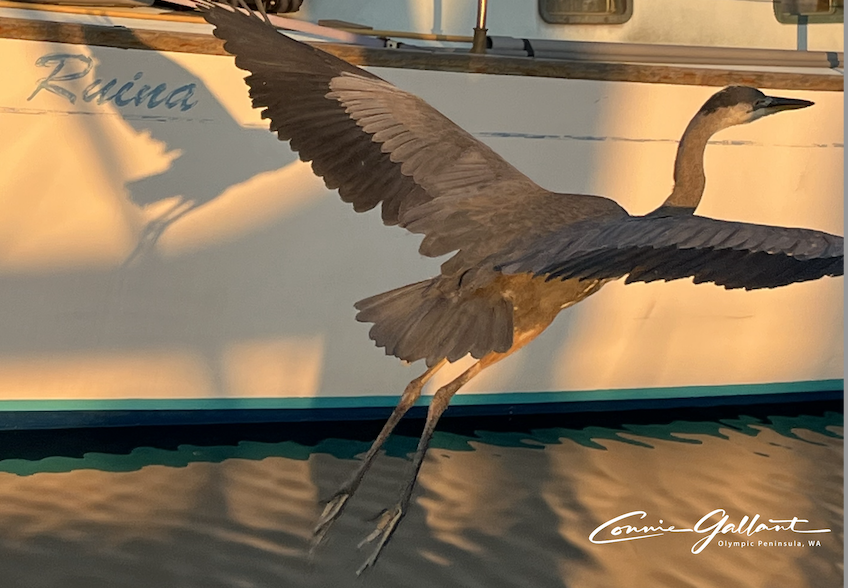
Connie's heron

Connie's heron
Connie Gallant of Quilcene writes: "While recently docked at the Boat Haven, Port Townsend, I got off my sailboat and while walking the dock early in the morning, this beauty was standing there, letting me get closer and closer. Finally it took off and I got this shot on my iPhone."

After 2-year pandemic pause, Seattle-BC train service returns
Amtrak service between Seattle and Vancouver, B.C., is back up and running as of Monday, Sept. 26. The service, which crosses the U.S.-Canada border, was shut down for two years by the Covid-19 pandemic...Just one daily round trip will be offered, at first, while Amtrak gets its staffing and equipment levels back up to par. (KUOW)

Bellingham council votes to suspend anaerobic digestion project
The City of Bellingham will stop pursuing anaerobic digestion projects at the Post Point Wastewater Treatment Plant following a unanimous city council vote Monday afternoon. (Bioenergy Insight)

Old volcanoes, big energy
Volcanoes beneath mountains near Whistler, B.C., hold a big green energy promise. But can scientists and industry deliver? Molly Segal reports. (CBC)

Heat-related mortality risk is widespread across Washington state, study shows
Heat-related deaths are an issue across Washington state, and they occur even in regions that typically have milder climates, according to a University of Washington study published Aug. 30 in the journal Atmosphere. This is the most extensive study yet of heat-related mortality in Washington state, and the first to look beyond the major population centers to include rural areas. Hannah Hickey reports. (UW News)

Notes from the field: The Illusion of abundance
How much do we really know about the health of seemingly abundant bird populations like pigeon guillemots on Protection Island? (Aug. 29) Eric Wagner reports. (Salish Sea Currents)

Bird populations improve after Elwha Dam removals
Dam removals are often associated with salmon recovery, but new research on the Elwha River suggests that birds also benefit. Scientists say birds are a sometimes-overlooked indicator of river health. (Aug. 22) Alyssa Sargent reports. (Salish Sea Currents)

On the Origins of Reef Fishes
Fossils pulled from the quarry of an ancient Maya city reveal the dawn of reef fishes. Jesse Kathan reports. (Hakai Magazine)

A Moonshot for Coral Breeding Was Successful
But the coral are trapped in tanks, still waiting to be released on the reefs. Alex Riley reports. (Hakai Magazine)

Camano's state parks boast unique pasts
On July 27, 1949, about 900 Stanwood and Camano area residents came together to build the Camano Island State Park in just one day. Organized by the South Camano Grange, volunteers gathered in the early hours on a temperate mid-summer day to get to work, tools in hand. Mary Jennings reports. (Stanwood Camano News)


Now, your tug weather--
West Entrance U.S. Waters Strait Of Juan De Fuca-  214 AM PDT Tue Sep 27 2022   
TODAY
 W wind to 10 kt rising to 10 to 20 kt in the afternoon.  Wind waves 1 ft or less building to 1 to 3 ft in the afternoon. W  swell 3 ft at 9 seconds. Areas of fog in the morning. A slight  chance of rain in the afternoon. 
TONIGHT
 NW wind 5 to 15 kt becoming E to 10 kt after midnight.  Wind waves 2 ft or less. W swell 4 ft at 10 seconds. Rain likely  in the evening then rain after midnight.


--
"Salish Sea News & Weather" is compiled as a community service by Mike Sato. To subscribe, send your name and email to mikesato772 (@) gmail.com. Your email information is never shared and you can unsubscribe at any time.

Salish Sea News: Communicate, Educate, Advocate

Follow on Twitter. 

Salish Sea Communications: Truth Well Told
Monday, September 26, 2022

9/26 Squirrelly, BC big trees, renaming WA locations, Whatcom extremist candidate, EPA enviro office, salmon crisis roots, Mamalilikulla, seaweed farms, eDNA


Squirrelly [Laurie MacBride]

September with Squirrelly
Laurie MacBride in Eye on Environment writes: "Squirrelly and I had a nice visit the other afternoon – a welcome break during a very busy season. We’re really quite alike, the two of us. Sure, he/she’s a North American Red squirrel (Tamiasciurus hudsonicus), and I’m a human (Homo sapiens), so at first you might not spot the resemblance – until September. That’s when you’ll find us both scurrying about, hard at work to bring in the harvest and store it away for the winter." Read more. (Eye on Environment)

BC’s Big Trees Protection Is Toothless. Government Knew It
Officials in British Columbia’s Forests Ministry understood that a regulation introduced in 2020 to protect big trees on public lands would have little impact. They designed it that way. Internal records released to The Tyee in response to a Freedom of Information request confirm critics’ suspicions that the Special Tree Protection Regulation was meant to sound good to the public while continuing to protect the interests of the logging industry. Andrew MacLeod reports. (The Tyee)

Derogatory term for Native women removed from WA creek, lake names
The U.S. Department of the Interior announced in September the new names for 19 geographic locations that previously included racist and sexist terms used to describe Indigenous women.  Alexandra Yoon-Hendricks reports. (Seattle Times)

Extremist and sexist memes, video scrubbed from Whatcom candidate’s social media
A Republican candidate for the state Legislature in Whatcom County has shared sexist and antisemitic memes online, promoted misinformation about COVID-19 and offered apparent support for anti-government militants. Dan Johnson of Laurel, a former towing company owner who’s running for the 42nd Legislative District’s position 2 House seat, also has apparently removed his vlog “The Hook News and Information” from the video streaming site YouTube and recently restricted access to his public Facebook page. Robert Mittendorf reports. (Bellingham Herald)

Biden administration launches environmental justice office
Forty years after a predominantly Black community in Warren County, North Carolina, rallied against hosting a hazardous waste landfill, President Biden’s top environment official visited what is widely considered the birthplace of the environmental justice movement Saturday to unveil a national office that will distribute $3 billion in block grants to underserved communities burdened by pollution...The Office of Environmental Justice and External Civil Rights — comprised of more than 200 current staff members in 10 U.S. regions — will merge three existing EPA programs to oversee a portion of Democrats’ $60 billion investment in environmental justice initiatives created by the Inflation Reduction Act. Hannah Schoenbaum report. (Associated Press/Report for America)

The racism, and resilience, behind today’s Pacific Northwest salmon crisis
There’s no one in this region whose life isn’t touched by the fish, whether they think about it or not. We populated towns to fish for salmon and can them. We sacrificed them for cheap electricity. Even the region’s iconic farming and timber industries wouldn’t be possible without salmon, whose dying bodies have enriched the Northwest soil with ocean nutrients. But for decades the injustice at the heart of that story has been systematically hidden. Tony Schick writes. (OPB)

The Mamalilikulla’s long journey home
A coastal B.C. First Nation dispossessed from its land for decades by colonialism is part of a groundswell of Indigenous nations declaring protected areas based on their own sovereignty — and they’re not waiting around for colonial governments. Stephanie Wood reports. (The Narwhal)

Rising tide: Pacific Northwest could soon double or triple its small number of seaweed farms
There's a rising tide of interest in opening seaweed farms in the Pacific Northwest. If even half of the current applicants succeed, it would more than double the small number of commercial seaweed growing operations in Oregon and Washington state. According to the Washington State Department of Natural Resources, there are now five prospective seaweed farmers with pending aquatic lease applications before the agency and another four more in the wings, for a total of nine in various stages of permitting. All of those proposals are located in the sheltered waters of Puget Sound. Tom Banse reports. (NW News Network)

With a few cups of water, scientists use eDNA to study reclusive, rare creatures off West Coast
Some critters in the ocean are reclusive, hiding from human probes and trawls. Other critters are rare, driven close to extinction from warming and increasingly acidic waters. Studying rare and reclusive creatures has posed problems for scientists in the past. In recent years, environmental DNA, or eDNA, has helped. To isolate eDNA, scientists scoop water from the ocean. Courtney Flatt reports.(OPB)


Now, your tug weather--
West Entrance U.S. Waters Strait Of Juan De Fuca-  209 AM PDT Mon Sep 26 2022   
TODAY
 Light wind becoming E to 10 kt in the afternoon. Wind  waves 1 ft or less. W swell 3 ft at 10 seconds. 
TONIGHT
 W wind 5 to 15 kt becoming to 10 kt after midnight.  Wind waves 2 ft or less. W swell 3 ft at 9 seconds.


--
"Salish Sea News & Weather" is compiled as a community service by Mike Sato. To subscribe, send your name and email to mikesato772 (@) gmail.com. Your email information is never shared and you can unsubscribe at any time.

Salish Sea News: Communicate, Educate, Advocate

Follow on Twitter. 

Salish Sea Communications: Truth Well Told

Friday, September 23, 2022

9/23 Coot, border restrictions, Seattle Green New Deal, rockfish poaching, GasLink drilling, Seattle Aquarium, Campbell R barge, natural world sounds, license buyback, recycling batteries, week in review

Coot [Wikipedia]

American Coot Fulica americana
The waterborne American Coot is one good reminder that not everything that floats is a duck. A close look at a coot—that small head, those scrawny legs—reveals a different kind of bird entirely. Their dark bodies and white faces are common sights in nearly any open water across the continent, and they often mix with ducks. But they’re closer relatives of the gangly Sandhill Crane and the nearly invisible rails than of Mallards or teal. Populations in the northern half of North America migrate to the southern U.S. or Central America. Populations in the West and Florida are year-round residents. (All About Birds)

Canada ending requirements for COVID-19 vaccines, ArriveCan app at border Sept. 30
The last of Canada's COVID-19 border restrictions will disappear at the end of this month with the expiry of a cabinet order affecting mandatory vaccinations, testing and quarantine of international travellers. Mia Rabson and Laura Osman report. (Canadian Press)

Mayor Harrell signs $6.5 million Green New Deal to reduce impact of climate change
[Seattle] Mayor Bruce Harrell signed the Green New Deal legislation into law Thursday morning, which includes a series of projects that aim to reduce greenhouse gas emissions in Seattle and build the communities' resilience against the effects of climate change. The Green New Deal legislation includes nearly $6.5 million earmarked for several climate projects throughout the city. Quixem Ramirez reports. (KING)

Pandemic Poaching Sets Rockfish Conservation Effort Back Years
Illegal fishing in rockfish conservation areas around Galiano Island, British Columbia, spiked dramatically in 2020 and 2021. Larry Pynn reports. (Hakai Magazine)

After years of resistance, Coastal GasLink starts to drill under Wet’suwet’en river
On the Morice River Forest Service Road southwest of Houston, B.C., the chatter of natural life is interrupted by pulsating construction equipment and the constant hum of industrial traffic. 'It’s really gut-wrenching,' Jocey Alec, daughter of Wet'suwet'en Hereditary Chief Woos, says. Brandi Morin reports. (The Narwhal)

An inside look at Seattle Aquarium’s expansion plans
Not far from the underwater dome, the otters, the octopus, the seals and the Window on Washington Waters, something new is coming. You can’t miss the construction out front, where the new Ocean Pavilion is taking shape. It is expected to open in 2024. Graham Johnson reports (KIRO)

How technology is mapping the unheard conversations of our natural world
When you step into a forest, or walk along a beach, there's a lot to take in – the sound of waves crashing against the sand, birds chirping to each other in the trees. But there's a lot we don't hear, and thanks to new technology, researchers are closer than ever to translating our natural world. Libby Denkmann, Alec Cowan and Sarah Leibovitz report. (KUOW)

Sunken barge near Campbell River to be removed, scrapped
The 98-metre Trailer Princess will be removed from the water, where leaking fuel continues to threaten the marine environment, and deconstructed for recycling. Darron Kloster reports. (Times Colonist)

'Too many boats chasing too few fish': Support, concern in B.C. salmon industry over DFO licence buyback plan
That dilemma is central to the federal government's Pacific salmon commercial licence retirement program, which, when launched later this year, will pay fishers to hand back their licences and walk away from the industry. It's a move the government says will help take pressure off salmon stocks, and a strategy similar to buybacks in Atlantic Canada, where the Fisheries and Oceans Canada (DFO) put forward a voluntary licence buyback program to limit commercial access to lobster fisheries. Georgie Smyth reports. (CBC)

The complicated process of recycling batteries in Washington state
More people are using batteries as battery-powered tools become bigger parts of our lives, from laptops to electric vehicles promising to release us from the grip of fossil fuels. But anything that holds a charge will ultimately need to be carefully disposed of. Hannah Weinberger reports. (Crosscut)

Salish Sea News Week in Review 9/23/22: Bisexuality Friday, Squamish R restoration, BC sea gardens, Seattle's river, global fossil fuel database, Coastal GasLink violations, Yukon sockeye, relocating trees, Seattle Green Deal, rockfish poaching

Now, your weekend tug weather--
West Entrance U.S. Waters Strait Of Juan De Fuca-  247 AM PDT Fri Sep 23 2022   
TODAY
 SE wind 5 to 15 kt. Wind waves 2 ft or less. W swell  2 ft at 10 seconds. A chance of showers. 
TONIGHT
 SW wind 5 to 15 kt in the evening becoming light. Wind  waves 2 ft or less. W swell 3 ft at 9 seconds. A slight chance of  showers in the evening. 
SAT
 Light wind. Wind waves less than 1 ft. W swell 3 ft at  9 seconds. 
SAT NIGHT
 Light wind. Wind waves less than 1 ft. W swell 4 ft  at 12 seconds. 
SUN
 Light wind. Wind waves less than 1 ft. W swell 4 ft at  10 seconds.

--
"Salish Sea News & Weather" is compiled as a community service by Mike Sato. To subscribe, send your name and email to mikesato772 (@) gmail.com. Your email information is never shared and you can unsubscribe at any time.

Salish Sea News: Communicate, Educate, Advocate

Follow on Twitter. 

Salish Sea Communications: Truth Well Told

Thursday, September 22, 2022

9/22 Nuttall's cockle, Aleutian Isle, sockeye return, relocating trees, Oly clearcut

Nuttall's cockle [WDFW]


Nuttall's cockle Clinocardium nuttallii
Nuttall's cockles grow to 5½ inches. They bury 1-2 inches deep in sandy, sheltered beaches and are also found in gravel and cobble substrate. Live cockles are also sometimes found lying on the beach surface. Cockles have a strong digger foot which they sometimes use to "jump" away from predators like the sunflower star. Clinocardium nuttallii has multiple common names. Several state agencies refer to them as 'heart cockles'. Many other sources call them some version of 'Nuttall's cockle' and also 'basket cockle'. All of these names refer to the same species, which is common on Puget Sound beaches. (WDFW)

Aleutian Isle recovered
On Tuesday, the Washington State Department of Ecology reported that the fishing vessel Aleutian Isle was safely and uneventfully transported to Mitchell Bay on San Juan Island Monday afternoon. "After the crane barge was secured, crews were able to remove 300 gallons of oily-water mix before operations ended for the day. A new safety zone was established around the new work area with a 150-yard radius that is in place until Sept. 26. On Tuesday, operations continued to remove trapped fuel and water. Crews also began re-rigging the vessel in preparation to lift it onto a barge in the next day or two where it will be transported to an on-shore facility. Wildlife crews are continuing bird deterrence efforts and assessing areas for any wildlife impacts. The whale deterrence team remains on standby in case killer whale deterrence is necessary." (Dept. of Ecology)

After decades of dwindling runs, sockeye salmon return to Yukon fishing village in droves
It's been more than 20 years since Champagne and Aishihik elder Chuck Hume has seen anything close to the number of sockeye salmon that have shown up to spawn at the Yukon fishing village of Klukshu this fall. Numbers are almost double the escapement goal so far, but it's not yet clear why the fish are back. Matt Meuse reports. (CBC)

The Forest Service is experimenting with relocating tree species to save them from climate change
‘Assisted migration’ has come to the Pacific Northwest, but experts don’t agree if it’s a good thing or a radical response to a warming world. Nathan Gilles reports. (Columbia Insight/Investigate West)

State logging permit voids decades of community planning
Until the last week of this July, there was a forest of 80– to 100–year–old trees in a residential neighborhood on Cooper Point Road between 20th and 28th Streets in Olympia. “Cooper Crest” was a legacy forest, thriving in the middle of Green Cove Basin on a steep hillside alive with springs that supply Green Cove Creek. A 25–acre stand of Douglas Firs and cedars presided over a critical area for aquifer recharge, provided habitat for diverse species, stabilized slopes to reduce landslides—and contributed to slowing global warming by sequestering carbon. That forest is gone now, clearcut by the investors of Silvimantle LLC under a permit granted by the state Department of Natural Resources (DNR). Esther Kronenberg and Jerry Dierker write. (Works in Progress)


Now, your tug weather--
West Entrance U.S. Waters Strait Of Juan De Fuca-  252 AM PDT Thu Sep 22 2022   
TODAY
 N wind to 10 kt. Wind waves 1 ft or less. W swell 3 ft  at 11 seconds. 
TONIGHT
 SW wind to 10 kt. Wind waves 1 ft or less. W swell  3 ft at 11 seconds. A slight chance of showers in the evening  then a chance of showers after midnight.


--
"Salish Sea News & Weather" is compiled as a community service by Mike Sato. To subscribe, send your name and email to mikesato772 (@) gmail.com. Your email information is never shared and you can unsubscribe at any time.

Salish Sea News: Communicate, Educate, Advocate

Follow on Twitter. 

Salish Sea Communications: Truth Well Told


Wednesday, September 21, 2022

9/21 Cranberrybush, Coastal GasLink, starving orcas, Quiet Skies, white roofs

American Cranberrybush [Native Plants PNW]


American Cranberrybush Viburnum opulus
The specific epithet, opulus appears to refer to the Italian Maple, Acer opalus (opalus for opal), due to its maple-like leaves, rather than any opulent characteristic.  Viburnum opulus is sometimes called Highbush Cranberry in our region. There are about 150-175 species of Viburnum in temperate regions of the Northern Hemisphere with a few species found in mountainous regions of South America, Southeast Asia & Africa (in the Atlas Mountains). There are about 20 native to North America. Many species are popular garden and landscape plants. Kalnya (Viburnum opulus) is a national symbol of Ukraine.  Ancient Slavs associated it with the birth of the universe.  Its berries symbolize blood and family roots. Kalyna is often depicted in Ukrainian embroidery. (Native Plants PNW)

A Pipeline, a River and an Indigenous Nation
Members of the Wet’suwet’en Nation who oppose the Coastal GasLink pipeline say they fear the company is about to begin drilling under the Morice River, known to Wet’suwet’en as Wedzin Kwa.  The river, and the potential for impacts from pipeline construction, have been central to the conflict that has been unfolding on Wet’suwet’en territory for more than a decade. Amanda Follett Hosgood reports. (The Tyee)

Coastal GasLink warned more than 50 times over environmental violations during pipeline construction
Coastal GasLink has now been warned more than 50 times about environmental violations during construction of its natural gas pipeline across northern British Columbia, according to the province. In an email to CBC News, the Ministry of Environment and Climate Change said it had issued a total of 51 warnings, 16 orders, and levied two fines — penalties of more than $240,000 "for repeated non-compliance" — since construction on the pipeline started in 2019.  Betsy Trumpeter reports. (CBC)

As chinook salmon get thinner and fewer, southern resident killer whales struggle to find enough food
As marine species continue to decline worldwide, the southern resident killer whale population — which now stands at 75 individuals — along the west coast of North America, has baffled scientists who are trying to understand why this population is struggling. Fanny Couture writes. (The Conversation)

Quiet Skies continues noise monitoring after ruling against U.S. Navy
On Aug. 2, environmentalists were delivered a long-awaited win in the case of the Navy vs. The State of Washington, halting the expansion of the Whidbey Base Navy’s Growler jet training program. Judge Richard Jones fully sided with the plaintiffs, stating the Navy could not move forward with the addition of 36 new warfare jets, and hundreds of thousands of more flights until they more fully considered the consequences of the jets’ loud presence in nearby fly-over regions. Kathryn Wheeler reports. (Islands' Sounder)

The Case for White Roofs
Time was, we didn’t worry much about summer heat on the wet side of the Pacific Northwest’s Cascade Curtain. A “hot day” meant 80 degrees Fahrenheit; over 90 was a rare scorcher, and 100 was unheard-of until one day in 1994 touch​​ed that mark. Feeling warm? Open a window, rummage in the basement for a fan, pop a cold one, and wait for the evening breeze to cool things down. Air conditioners, like umbrellas, were for wimps and tourists. All of that started changing in 2015, when Seattle saw a record 12 days of 90-plus weather and Earth embarked on its hottest seven years (and counting) ever recorded. Eric Scigliano writes. (The Atlantic/Post Alley)


Now, your tug weather--
West Entrance U.S. Waters Strait Of Juan De Fuca-  256 AM PDT Wed Sep 21 2022   
TODAY
 E wind to 10 kt in the morning becoming light. Wind  waves 1 ft or less in the morning becoming less than 1 ft. W  swell 3 ft at 12 seconds. 
TONIGHT
 W wind 10 to 20 kt. Wind waves 1 to 3 ft. W swell 2 ft  at 12 seconds.


--
"Salish Sea News & Weather" is compiled as a community service by Mike Sato. To subscribe, send your name and email to mikesato772 (@) gmail.com. Your email information is never shared and you can unsubscribe at any time.

Salish Sea News: Communicate, Educate, Advocate

Follow on Twitter. 

Salish Sea Communications: Truth Well Told