Tuesday, May 10, 2016

5/10 GPT coal port, Esquimalt spill, bag ban, electronic waste, Prince Rupert port, Burrard Inlet, halogen radicals

Terminal terminated
Army Corps rejects permit for coal terminal at Cherry Point
 The proposed coal terminal for Cherry Point is dead after the U.S. Army Corps of Engineers denied a needed permit Monday, May 9. The Corps ruled the project would impact the treaty-protected fishing rights of Lummi Nation based on the fact that the proposed trestle and associated wharf would take up 144 acres over water. “The Corps may not permit a project that abrogates treaty rights,” said Col. John Buck, commander of the Corps’ Seattle District. Samantha Wohlfeil reports. (Bellingham Herald) See also: Tribes prevail, kill proposed coal terminal at Cherry Point  Lynda Mapes reports. (Seattle Times) And also: A death blow to coal ports in Washington?  Floyd McKay reports. (Crosscut)

Cleanup underway after barge runs aground in Esquimalt Harbour
Cleanup crews are focusing on the shoreline of Plumper Bay after a barge carrying up to 30,000 litres of diesel ran aground in Esquimalt Harbour. Vancouver Pile Driving said its construction barge contained between 20,000 and 30,000 litres when it broke loose in high winds early Sunday morning and hit the shore. On Monday, a red Canadian Coast Guard helicopter circled over the small protected bay surveying the impact of the spill. The large construction barge, which carries a crane, ran aground near the mouth of Plumper Bay. The sandy rock-strewn beach is ringed by Esquimalt Nation on one side and Songhees Nation on the other. Cindy E. Harnett reports. (Times Colonist)

Plastic bag ban proposed for San Juan County
Should single-use plastic bags be banned in San Juan County? The idea was put to the county council last week by solid waste program administrator Mark Herrenkohl, who is spearheading a public works effort to pass a ban here…. Herrenkohl and public works director Brian Vincent suggested San Juan County adopt a resolution similar to those passed in other regional communities. (San Juan Journal)

On the trail of America's dangerous, dead electronics
High above the Pacific Ocean in a plane headed for Hong Kong, most of the passengers are fast asleep. But not Jim Puckett. His eyes are fixed on the glowing screen of his laptop. Little orange markers dot a satellite image. He squints at the pixilated terrain trying to make out telltale signs. He’s searching for America’s electronic waste…. He doesn’t know it yet, but on this trip to Hong Kong, he will stumble on boxes bearing the logo for Total Reclaim, one of the largest electronics recyclers in the Pacific Northwest, with contracts to handle e-waste from the City of Seattle, King County, the University of Washington, and the State of Washington. Katie Campbell & Ken Christensen report. (KUOW)

Seattle, Tacoma ports battling much smaller BC neighbor
Remote just begins to describe it. As legend has it in these parts, Ketchikan is about 60 miles away as the crow flies.  It's tough to get here by road. Yet, Prince Rupert, British Columbia, population 12,000, is now on a path to arguably become the biggest threat to the Puget Sound economy. "We're quite happy," said Port of Prince Rupert CEO Don Krusel, who describes his town and port as a "real success story."… At the port's interpretive center, visitors can see the sales job.  This port bills itself a day closer to the Far East than Seattle or Tacoma, and it doesn't need trucks. Ships can pull in and off-load right onto on-dock rail, which can take cargo to the upper midwest and southern United States days earlier. Chris Daniels reports. (KING)

Water's Edge: Park life and sulphur piles in Burrard Inlet, where homes coexist with industry 
Larry Pynn writes: "For 15 minutes I pinball around the offices of the Tsleil-Waututh First Nation — “People of the Inlet” — until a decision is made allowing me to launch my kayak from a small rocky beach next to the canoe shed on Dollarton Highway in North Vancouver. The band’s director of administration, Dale Komanchuk, even writes a note of authorization on the back of his business card in case anyone challenges me, and allows me to park my pickup truck overnight behind the community centre. I launch over several dozen dead prawns visible on the ocean floor then paddle toward Maplewood Flats Conservation Area, a haven for birds featuring 96 hectares of intertidal area and 30 hectares of uplands. The late novelist, Malcolm Lowry, wrote Under The Volcano while living in a squatter cabin near here, but there’ll be no investigating literary ghosts today. I can barely skim across the exposed mud on a receding tide even staying 200 metres off shore and wisely decide to reverse course and continue eastward through the inlet…." (Vancouver Sun)

Engineers discover good and bad seawater salt effects on coastal algae
Scientists have long studied the role that free radicals play in freshwater because of how these charged compounds affect the chemistry of our drinking water. The special nature of these processes in saltwater ecosystems, however, has been poorly understood. Now civil and environmental engineers at Stanford have discovered how salty free radicals in seawater act as a double-edged sword – sometimes they break down poisonous byproducts of algae but at other times they diminish the supply of beneficial algal byproducts. Writing in Proceedings of the National Academy of Sciences, Associate Professor William Mitch and PhD student Kimberly Parker explore the effects of a seawater-specific category of chemical agents known as halogen radicals. Shana Tonn reports. (Phys.org)

Hawks used to scare away unwanted birds
Playing tennis on courts covered with bird droppings is no fun. That’s where Lummi and Roslyn, a couple of skilled Harris’s hawks, come into play. The two hawks, along with owner Sue Hanneman, have been busy the past couple of weeks scaring away unwanted starlings from the covered courts at Skagit Valley College. Vince Richardson reports. (Skagit Valley Herald)

Now, your tug weather--
WEST ENTRANCE U.S. WATERS STRAIT OF JUAN DE FUCA-  245 AM PDT TUE MAY 10 2016  

TODAY
 LIGHT WIND...BECOMING NW 5 TO 15 KT IN THE AFTERNOON. WIND  WAVES LESS 2 FT OR LESS. W SWELL 5 FT AT 9 SECONDS.

TONIGHT
 W WIND 5 TO 15 KT...BECOMING SW TO 10 KT AFTER MIDNIGHT.  WIND WAVES 2 FT OR LESS. W SWELL 3 FT AT 9 SECONDS.

--
"Salish Sea News & Weather" is compiled as a community service by Mike Sato. To subscribe, send your name and email to msato@salishseacom.com. Your email information is never shared and you can unsubscribe at any time.

Salish Sea News: Communicate, Educate, Advocate

Follow on Twitter.

Salish Sea Communications: Truth Well Told

Monday, May 9, 2016

5/9 Sky views, sea star babies, BC pipe, BC port, whale sanctuary, Thurston toxins, Site C protest, BCCG

(KOMO)
Epic Northern Lights show dazzles Puget Sound region
Sunday might be Mother's Day but it was Mother Nature who was doling out the gifts, especially to photographers who happened to heed the geomagnetic warnings and head to a spot with a clear northern view. Because Sunday morning may have been among the most intense Northern Lights shows in several years in the Puget Sound region. Scott Sistek reports. (KOMO)

Here’s how to watch today’s Mercury transit
The planet Mercury began its rare journey passing between the Earth and Sun on May 9, 2016. It takes this trek only about 13 times a century. The last time it made this journey was in 2006. Mercury will appear as a small black dot on the face of the Sun. See the beginning of the journey, which will last more than 7 hours here. Elizabeth Koh reports. (McClatchy)

Starfish baby boom follows a major West Coast die-off
Droves of baby starfish are returning to Oregon and Northern California’s shores after a wasting disease decimated whole populations of the creatures over the past two years along the West Coast. Data collected by Oregon State University researchers shows an unprecedented number of baby starfish, or sea stars, survived the summer and winter of 2015, the Eureka Times Standard reported Saturday. “When we looked at the settlement of the larval sea stars on rocks in 2014 during the epidemic, it was the same or maybe even a bit lower than previous years,” Oregon State University marine biology professor Bruce Menge said in a statement. “But a few months later, the number of juveniles was off the charts — higher than we’d ever seen — as much as 300 times normal.” (Associated Press)

Proponents behind B.C.'s Northern Gateway pipeline ask for three-year extension
The proponents behind the Northern Gateway pipeline are asking the National Energy Board for three more years to start building the controversial project. Northern Gateway and 31 aboriginal equity partners said Friday they need the time to secure legal and regulatory certainty and continue consultations with First Nations and Metis communities. (Canadian Press)

Water's Edge: Industry versus nature in Canada's busiest port
When we look out at the craggy industrial face of the Port of Vancouver, we see freighters from around the world, piles of sulphur and coal, grain unloaded from rail cars into silos, commercial float planes, tugs, ferries and gantries moving container cargo. Much less obvious is the natural world that defies the odds and makes its home within the bustling waters and unyielding infrastructure of the inner harbour. At Harbour Green Park at Cordova and Bute, a half-circle of large orange buoys gives no indication of the protected forests of bull kelp and fish flourishing beneath the surface. Next door, Vancouver Convention Centre delegates are oblivious to the range of conservation measures built in to the facility. Crew substituted clean soils for sediments polluted with old industrial hydrocarbons, constructed reef, shoal and islet habitat, and installed pipes for rockfish, and heavy chains for invertebrates. Some 100 marine species are thought to frequent the site, about one-third more than before construction of the facility in 2009. Larry Pynn reports. (Vancouver Sun)

Pacific Northwest Coast Scouted For Possible Seaside Whale Sanctuary
A new environmental nonprofit is scouting the Pacific Northwest coast for a suitable cove or bay to establish a refuge for retired captive orca and beluga whales. The board and staff of the new outfit, called The Whale Sanctuary Project, includes a number of people who helped return Keiko, the star of the Free Willy movie, to Icelandic waters from Newport, Oregon. Whale Sanctuary Project Executive Director Lori Marino said her group is searching for a cold water home on the East Coast or along the Washington or British Columbia waterfront. Tom Banse reports. (KUOW)

10 most toxic Thurston County properties have worst threat rating
At the end of Buckeye Court sits an abandoned property with a dirty backstory. This uninhabitable half-acre parcel near Black Lake was under investigation more than a decade ago for its role in a gasoline theft operation. The site reeked of gasoline when four 55-gallon drums full of stolen fuel were found alongside hand-operated pumps and plastic tubes. Gasoline had spilled on the soil and, at the time, an environmental report warned of the potential for toxic chemicals to wash downhill into the wetlands less than 1,000 feet away. Andy Hobbs reports. (Olympian)

Researchers implant electronic tags to track journey of juvenile salmon
Using tags surgically implanted into thousands of juvenile salmon, UBC researchers have discovered that many fish die within the first few days of migration from their birthplace to the ocean…. Researchers from the Pacific Salmon Ecology and Conservation Laboratory at UBC followed the migration of one of B.C.'s largest sockeye populations from Chilko Lake, in British Columbia's Cariboo region, to the ocean. Each spring, juvenile salmon known as smolts leave this central B.C. lake and migrate downstream through the Chilko, Chilcotin, and Fraser rivers and into the Salish Sea. To follow the juvenile salmon, researchers implanted small electronic tags into the tiny 12-centimetre fish as they were leaving Chilko Lake. As the smolts made the 1,000-kilometre journey to the Pacific Ocean, acoustic receivers picked up the signals from the tags to monitor how many fish survived the migration. (Phys.org)

Site C protesters to dismantle camp outside Vancouver BC Hydro office
Opponents of a major hydroelectric dam project in northern British Columbia are packing up a protest camp outside BC Hydro's Vancouver office. The decision came more than a week after the utility filed a notice of civil claim and an application for an injunction in a bid to evict Site C protesters who have been stationed outside the head office 24 hours a day since March 13. Julia Ratcliffe, one of the people named by BC Hydro in court documents, said she decided to settle with the company outside of court. (Canadian Press)

Most MPs endorse Comox coast guard station shutdown: Report
A House of Commons committee gave its conditional nod of approval Friday to the federal government’s planned closure next week of a communications station in Comox. Liberal and Conservative MPs on the committee, overriding the objections of the New Democratic Party, accepted the Canadian Coast Guard’s argument that mariner and public safety won’t be threatened by the move. “The committee has been sufficiently reassured that the capacity of the Canadian Coast Guard to respond to emergency situations has not diminished,” stated a news release issued following the tabling of the report in Parliament. Peter O'Neil reports. (Vancouver Sun)

Now, your tug weather--
WEST ENTRANCE U.S. WATERS STRAIT OF JUAN DE FUCA-  243 AM PDT MON MAY 9 2016  

TODAY
 NW WIND 5 TO 15 KT. WIND WAVES 2 FT OR LESS. W SWELL 6 FT  AT 10 SECONDS.

TONIGHT
 W WIND 10 TO 20 KT...BECOMING SW TO 10 KT AFTER  MIDNIGHT. WIND WAVES 1 TO 3 FT...SUBSIDING TO 1 FT OR LESS AFTER  MIDNIGHT. W SWELL 6 FT AT 10 SECONDS.

--
"Salish Sea News & Weather" is compiled as a community service by Mike Sato. To subscribe, send your name and email to msato@salishseacom.com. Your email information is never shared and you can unsubscribe at any time.

Salish Sea News: Communicate, Educate, Advocate

Follow on Twitter.

Salish Sea Communications: Truth Well Told


Friday, May 6, 2016

5/6 Wyckoff Superfund, BC LNG & oil pipes, ocean acid, fish protection, bag ban, Mercury transit

Bye-bye lawn, hello wildness.
America's Love of the Lawn
According to NASA, there are about 63,000 square miles of lawn in the US — nearly enough to cover the state of Wisconsin. That’s bad news, because most birds... prefer shrubs that provide food and cover. And lawns suck up fertilizers, herbicides, fossil fuels, and extraordinary quantities of water. Fortunately, lawns are also easy to replace with bird-friendly elements: borders or islands of dense, fruiting shrubs, layers of foliage for shelter, and wildflowers to attract native pollinators. (BirdNote)

Wyckoff Superfund site's 'final' plan proposed
After nearly 30 years of slow, expensive cleanup, a "final" solution has been proposed for one of the most polluted spots on Puget Sound. The U.S. Environmental Protection Agency has dug up, pumped out and covered portions of the Wyckoff Superfund site on Eagle Harbor — yet vast quantities of toxic tar and other harmful chemicals remain in the ground and on the beach. Now the EPA hopes to try a new strategy: injecting wet cement into the ground to freeze contaminants in place. Once hardened, the underground reservoirs of creosote and other chemical compounds would no longer threaten to seep into groundwater or ooze into the harbor, according to the EPA. Tristan Baurick reports. (Kitsap Sun)

TransCanada gets final permits for Coastal GasLink pipeline to Kitimat
TransCanada says it has secured the final permits needed to start construction and operation of its proposed Coastal GasLink pipeline. The company said Thursday that the B.C. Oil and Gas Commission issued the last two of 10 permits needed and it now is awaiting a final investment decision from LNG Canada before starting construction. The 650-kilometre pipeline would link natural gas fields in northeastern British Columbia to LNG Canada's proposed liquefied natural gas export project in Kitimat, B.C. The Shell-led LNG Canada consortium is expected to make a final investment decision on the natural gas project in late 2016 and, if approved, TransCanada could start pipeline construction next year. (Canadian Press)

Kinder Morgan review: Ottawa now promises consultative panel
Natural Resources Minister Jim Carr, in a speech just two days after his office said he would appoint a single envoy to gauge public views on the Kinder Morgan pipeline project, promised Thursday a “panel of ministerial representatives” to do that job. The switch is coming more than three months after the Trudeau government announced that the public would have a fresh chance to weigh in on the $6.8-billion expansion of the oilsands pipeline from Edmonton to Burnaby. And it comes roughly two weeks before Carr has promised to unveil the identity of those being asked to help the government improve its public outreach on pipelines. Peter O'Neil reports. (Vancouver Sun)

New West Coast mission investigates ocean acidification threat
Ocean acidification, a global process in which the ocean absorbs carbon dioxide from the atmosphere, is occurring faster than at any time in the past 50 million years. The global rise in ocean acidity, fueled by human-created greenhouse gases, is already affecting West Coast oyster hatcheries and the ability of tiny sea snails—an important food for salmon and herring—to build and maintain their shells…. During the monthlong cruise aboard NOAA Ship Ronald H. Brown, some 36 scientists from the United States, Mexico, Canada and Europe will collect ocean data to measure acidity, temperature, oxygen and chlorophyll from 16 locations stretching from Mexico to Canada. They will also deploy tow nets to sample sea snails and other ocean plants and animals to analyze how they are being affected by acidifying waters. (Phys.Org)

Fisheries protections are under threat
…. The days of sitting in a small rowboat fishing for 25-pound salmon just off Shilshole in north Seattle, rocking in the wake of the local salmon fishing fleet, are long-gone memories because all those big and continuing threats have already reduced the once-abundant fish populations. It is quite likely that no one will be general fishing for salmon in Puget Sound this year. Coho runs are expected to be exceptionally low and the opportunity to fish for winter-run steelhead is only half of what it was. Up the Skagit River, the community of Marblemount no longer sees out-of-state tourists vying for RV and hotel accommodations in winter and spring to fish for wild steelhead — instead, it looks like a town in decline. On my trip to D.C., I was surprised to learn that there is notable pressure to weaken the Magnuson-Stevens Act. Rather than roll back the law, I encouraged our congressional representatives to strengthen the law when it is updated again, to make sure that the growing knowledge about our ocean environment is used to better inform fishery management decisions. Bob Margulis writes. (Crosscut) See also: Total shutdown of Puget Sound salmon season sparks anger  (Associated Press/KOMO)

Thurston County launches new survey to gauge impact of plastic bag ban 
Plastic carryout shopping bags have been banned in Olympia, Lacey, Tumwater and unincorporated Thurston County for nearly two years, which means it’s time to look at the financial impact of the ban and other factors through a new survey and interviews. That was a requirement written into the bag ban ordinance, which took effect on July 1, 2014. And one aspect of the survey is already under way, according to the county. As of this week, the county is asking the owners and managers of retail businesses to take an online survey this month to determine the financial impact on those businesses as a result of the ordinance. To take the survey, go to: www.surveymonkey.com/r/ThurstonBagBan. Rolf Boone reports. (Olympian)

Best whale video you will ever see
Captain Cy Williams of Strike Zone Sportfishing in Ketchikan, Alaska shot this video of a giant humpback whale feeding just off the dock at Knudson Cove Marina. Scott Brown reports. (Vancouver Sun)

Mercury transit: How to watch the rare event
A rare daytime celestial show takes place on Monday. The planet Mercury will pass in front of the sun, and Canadians will get an exceptional view. Such "transits" of Mercury only happen 13 times a century, and not all of them are visible from all parts of the world…. his particular Mercury transit has great timing — Mercury will appear as a tiny dot on the east side of the sun at 7:12 a.m. ET and slowly cross it over 7½ hours, disappearing on the west side of the sun at 2:42 p.m. ET. That will make the entire event visible from most of Canada — with the proper equipment, of course. Emily Chung reports. (CBC)

Now, your weekend tug weather--
WEST ENTRANCE U.S. WATERS STRAIT OF JUAN DE FUCA-  242 AM PDT FRI MAY 6 2016  

TODAY
 LIGHT WIND...BECOMING NW 10 TO 20 KT IN THE AFTERNOON.  WIND WAVES LESS THAN 1 FT...BECOMING 1 TO 3 FT. W SWELL 5 FT AT  11 SECONDS.

TONIGHT
 W WIND 10 TO 20 KT...BECOMING 5 TO 15 KT AFTER MIDNIGHT.  WIND WAVES 1 TO 3 FT. W SWELL 5 FT AT 10 SECONDS.

SAT
 W WIND 5 TO 15 KT...RISING TO 15 TO 25 KT IN THE AFTERNOON.  WIND WAVES 2 FT OR LESS...BUILDING TO 2 TO 4 FT. W SWELL 6 FT AT  10 SECONDS.

SAT NIGHT
 W WIND 15 TO 25 KT. WIND WAVES 2 TO 4 FT. W SWELL 9 FT  AT 11 SECONDS.

SUN
 W WIND 10 TO 20 KT...RISING TO 15 TO 25 KT IN THE AFTERNOON.  WIND WAVES 2 TO 4 FT. W SWELL 9 FT AT 11 SECONDS.

--
"Salish Sea News & Weather" is compiled as a community service by Mike Sato. To subscribe, send your name and email to msato@salishseacom.com. Your email information is never shared and you can unsubscribe at any time.

Salish Sea News: Communicate, Educate, Advocate

Follow on Twitter.

Salish Sea Communications: Truth Well Told

Thursday, May 5, 2016

5/5 Dam salmon, closed season, Polley mine, state ferries, climate kids, coal ports, droughts

Columbia and Snake River dams (bluefish.org)
Judge: Salmon recovery requires big dam changes
A federal judge has called for a new approach to Columbia and Snake River dam operations to preserve salmon and steelhead, with all options on the table for consideration, including dam removal on the Lower Snake River. U.S. District Court Judge Michael Simon in Oregon on Wednesday invalidated the U.S. government’s 2014 Columbia Basin biological opinion, under which federal agencies operate the Columbia River hydropower system. It’s the fifth time a biological opinion written by the agencies permitting operation of the dams has been struck down by the courts. In his sweeping, 149-page ruling, Simon sounded about out of patience, quoting rulings over two decades by his predecessors denouncing a system that “cries out for a major overhaul,” and urging consideration of breaching one or more of the four dams on the Lower Snake River.  Lynda Mapes reports. (Seattle Times)

Fishermen protest tribal fishery as Puget Sound closure begins
With the closure of Puget Sound salmon fisheries this week and the possibility of no summer fishing season, about 20 fishermen gathered Wednesday morning in La Conner to protest the start of a tribal fishery. Nontribal fishermen at the protest said if they can’t fish, the tribes shouldn’t either…. Northwest Indian Fisheries Commission Chair Lorraine Loomis said Swinomish Indian Tribal Community fishermen are gathering chinook salmon this week in preparation for annual ceremonies, including the tribe’s Blessing of the Fleet. Kimberly Cauvel reports. (Skagit Valley Herald) See also: Sport fishermen protest ‘broken’ program as tribe gillnets chinook  Hal Bernton reports. (Seattle Times)

Mount Polley: Mines minister accepts scathing report but won't resign
B.C.'s minister of energy and mines said he will consider the recommendations from a damning report by the province's auditor general that concluded his ministry's regulation of the mining industry does not adequately protect British Columbians from significant environmental risks. However Bill Bennett did not agree with Auditor General Carol Bellringer's finding that his ministry failed to carry out its own regulatory oversight in the case of the tailings-pond dam at the Mount Polley mine which failed in August 2014. Gavin Fisher reports. (CBC) See also: Alaska raises concerns with B.C.’s mining oversight after audit  Justine Hunter reports. (Globe and Mail)

State says more ferries needed for aging fleet
Washington state is moving closer to adding a new ferry to its fleet. But before that, one of its older vessels will likely enter retirement. The state hopes to have a 144-car Olympic class ferry on the waters of Puget Sound by next year. By then the much smaller Hiyu ferry will likely be gone, according to state transportation officials. Even with the future additions to the fleet, the state will still need more vessels to accommodate a record amount of ridership. Michael Konopasak reports. (KING)

Climate Kids Win
A judge’s ruling on Friday in a lawsuit filed by eight kids forces the state of Washington to get serious about the threat of climate change. In what the activist teens and preteens called a surprise decision, King County Superior Court Judge Hollis Hill ordered the state Department of Ecology to create rules to reduce greenhouse gas emissions by the end of 2016. The judge said the urgency of climate change and the state’s responsibility to protect citizens required that Ecology be held to a deadline, rather than make its own timeline… The ruling reversed a November decision that left the timeline to craft emissions-reducing rules to the state. Hill said then that the state has a “mandatory duty” to “preserve, protect and enhance the air quality for the current and future generations.” But because Ecology was already working on new regulations ordered by Gov. Jay Inslee, additional rules weren’t necessary, she said then…. he judge ordered the state to produce rules cutting greenhouse gas emissions by the end of the year, and to make recommendations to the state legislature during its 2017 session to align emission-reduction goals with current science. She also ordered Ecology to consult with the youth petitioners as they draw up the plans. Peter Hart reports. (Cascadia Weekly)

How economics turned NW coal ports into the walking dead
Those dominos just keep falling. Not so long ago, it seemed as if every time you turned around, somebody new was proposing to ship fossil fuels through the Pacific Northwest. The Salish Sea and the Columbia River were going to become greenhouse gas central. Now, a lot of those proposals have floundered and others look less plausible. Last month, Oregon LNG abandoned its effort to build a liquefied natural gas export facility at the mouth of the Columbia River. Four days later, Northwest Innovation Works scrapped its lease for a site to build a methanol plant at the port of Tacoma. Daniel Jack Chasan reports. (Crosscut)

B.C. has seen worse droughts than previously thought, tree rings reveal
Residents on B.C.'s South Coast will likely have to endure worse droughts in the coming decades than previously thought according to a new study from the University of Victoria. Researchers used tree ring data to reveal centuries of B.C.'s water history — much further back than the 50 or so years that humans have been keeping stream-flow records. Looking at more than 350 years of tree ring data from B.C.'s South Coast, the study found 16 historical droughts that were worse than the benchmarks used today by water managers in the region, said Bethany Coulthard, paleoclimatologist and lead author of the study, published in the Journal of Hydrology. She said B.C. should expect future droughts to reach the extremes of the past — and then some, due to added factors including human-caused climate change. Wanyee Li and Lisa Johnson report. (CBC)

Whatcom County beaches closed to recreational shellfish harvesting
Health officials have closed all Whatcom County beaches to recreational shellfish harvesting after tests showed unsafe levels of marine biotoxins. The closure is for all molluscan shellfish including clams, mussels, oysters and scallops, and all beaches, including at Larrabee State Park and Point Roberts. The ban was put into place after unsafe levels of the toxin that causes diarrhetic shellfish poisoning were detected in recent sampling in Bellingham Bay. (Bellingham Herald)

Now, your tug weather--
WEST ENTRANCE U.S. WATERS STRAIT OF JUAN DE FUCA-  248 AM PDT THU MAY 5 2016  

TODAY
 W WIND TO 10 KT...BECOMING NW 5 TO 15 KT IN THE AFTERNOON.  WIND WAVES 2 FT OR LESS. W SWELL 6 FT AT 8 SECONDS.

TONIGHT
 W WIND 10 TO 20 KT. WIND WAVES 1 TO 3 FT. W SWELL 5 FT  AT 12 SECONDS.

--
"Salish Sea News & Weather" is compiled as a community service by Mike Sato. To subscribe, send your name and email to msato@salishseacom.com. Your email information is never shared and you can unsubscribe at any time.

Salish Sea News: Communicate, Educate, Advocate

Follow on Twitter.

Salish Sea Communications: Truth Well Told


Wednesday, May 4, 2016

5/4 #GiveBIG, salmon fishery, Break Free, BC mines, LNG slump, USCG survey, bank erosion

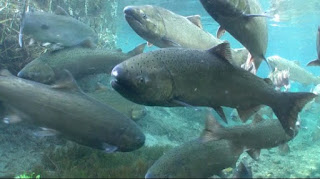
Spring Chinook (Michael Humling/USFWS)
GiveBIG Extended to Midnight Wednesday, May 4
A rush of online donors slowed Seattle Foundation's web site yesterday so GiveBIG, where you can direct your one-time donation to our community's hard-working nonprofits, is extended to midnight tonight. (As of 6:26 AM Wednesday, $11,372,503 has been raised from 56,943 gifts.) Your turn now.

Sport fishermen protesting in La Conner on Wednesday as tribal gill-net salmon fishery gets underway
Despite what is regarded as an unprecedented salmon fishing closure in all of Puget Sound by sport, tribal and non-tribal commercial fishermen, it appears the Swinomish Tribe has gotten approval to conduct a nine-day gill-net fishery directed at spring chinook on the Skagit River and Skagit Bay. The 25 boat Swinomish Tribal gill-net chinook salmon fishery begins on Wednesday (May 4) at 8 a.m. through Friday (May 6) at 8 a.m. with other dates planned on May 9-11 and May 16-18. NOAA Fisheries indicates this fishery will have limited impacts on wild chinook stocks of concern. However, the Puget Sound Anglers of Washington – a sport fishing advocacy group – doesn’t feel the same way, and in response will be conducting a protest at 9 a.m. on Wednesday at Rainbow Bridge that connects Fidalgo Island and La Conner in Swinomish Channel in Skagit County. Mark Yuasa reports. (Seattle Times)

Protestors plan gathering at Deception Pass park
At least 1,200 people are expected to mass at March Point in Anacortes May 13-15 to protest U.S. reliance on fossil fuels, tying up half the campsites at Deception Pass State Park and jeopardizing a vital Puget Sound Energy electrical substation, Eric Brooks, the county’s deputy emergency-management director, told the Council of Governments last week. Protest group Break Free PNW plans to “put our bodies on the line to stop the fossil-fuel economy and change history” at that event, according to its website. “Hundreds of people will risk arrest by engaging in peaceful civil disobedience.” The Shell and Tesoro refineries at March Point are responsible for 47 percent of all the gasoline and diesel consumed in the Northwest, the group said. Dan Richman reports. (Whidbey News-Times)

Auditor general slams B.C. for failing to adequately monitor mines
British Columbia's auditor general has delivered a scathing report that concludes the government is not properly prepared to protect the environment from potential disasters in the mining industry. Carol Bellringer said Tuesday that her office's mines audit was already underway in August 2014 when the tailings dam at the Mount Polley mine in central B.C. collapsed, spilling millions of cubic metres of silt and waste into nearby lakes and rivers. Her report, "An Audit of Compliance and Enforcement of the Mining Sector," took two years to complete, and it questions whether the province can properly protect the environment from risks posed by mines. (Canadian Press)

Canadian LNG prospects keep getting worse as prices tank and red tape delays projects
By now, B.C. should be rolling in cash from its burgeoning LNG industry — tens of thousands of new jobs, billions in potential royalties and a roaring economy with all the new investment into the province. Instead, it's still waiting for ground to break on any new facility, or even a final investment decision for an LNG plant. While several liquefied natural gas (LNG) plants are proposed, they have all struggled to get off the ground as they wait for regulatory approval, delay making spending decisions, or cancel plans altogether. A collapse in global LNG prices is the main culprit for why so many Canadian LNG export projects are in limbo or no longer make economic sense. Kyle Bakx reports. (CBC)

Coast Guard seeks public comment for Admiralty Inlet waterways analysis
U.S. Coast Guard officials are seeking public comment while conducting a waterways analysis and management system (WAMS) review of Admiralty Inlet. Officials are seeking information from local mariners regarding the general use of the waterways and any issues with the visibility, placement or location of aids to navigation in that area before the public comment deadline of July 31, 2016. Admiralty Inlet is the waterway connecting the Strait of Juan de Fuca (Pacific Ocean) and Puget Sound…. For a map of the WAMS review and the questionnaire form, visit the Coast Guard 13th District’s WAMS website at uscg.mil/d13/dpw/wams.asp. (Port Townsend Leader)

Willows offer solution to Saanich's erosion
Water seeps out about halfway down the terraced bank of George Zeman’s property. Zeman has no idea how much water from the Gordon Head water table is flowing out the middle of his embankment on a sunny Tuesday afternoon, but it jets out in streams when it rains, he says. From his beachfront yard, which is high on a hill just off Ash Road near Mount Douglas, it’s about 100 feet down, a dangerous 64 degree slope to the section of beach just south of Arbutus Cove. In recent years the bank of the property was slowly collapsing, unstable and at risk, but not anymore. Last month, a crew led by innovative soil bioengineer David Polster stabilized the bank with nearly 1.5 kilometres of linear waddling – a terrace that’s staircase like – made out of stakes and branches of native willow. The stakes are driven into the ground, and the branches laid sideways. Travis Paterson reports. (Saanich News)

Now, your tug weather--
WEST ENTRANCE U.S. WATERS STRAIT OF JUAN DE FUCA-  257 AM PDT WED MAY 4 2016  

SMALL CRAFT ADVISORY IN EFFECT THIS EVENING
 

TODAY
 NW WIND 10 TO 20 KT. WIND WAVES 1 TO 3 FT. W SWELL 6 FT AT  9 SECONDS.

TONIGHT
 W WIND 15 TO 25 KT...BECOMING NW 5 TO 15 KT AFTER  MIDNIGHT. WIND WAVES 2 TO 4 FT...SUBSIDING TO 2 FT OR LESS. W  SWELL 5 FT AT 9 SECONDS.

--
"Salish Sea News & Weather" is compiled as a community service by Mike Sato. To subscribe, send your name and email to msato@salishseacom.com. Your email information is never shared and you can unsubscribe at any time.

Salish Sea News: Communicate, Educate, Advocate

Follow on Twitter.
 

Salish Sea Communications: Truth Well Told
Tuesday, May 3, 2016

5/3 Elwha, lead, enviro justice, green Seaport, BC LNG, septic fund, Kids Preserve, Big Mama, invasives

Elwha 4/30/16 (Tom Roorda/Coastal Watershed Institute)
River Delta's Rebirth
The Elwha River’s rebirth happened in dramatic fashion. There were explosions that ripped out dams. There were floods that bled lakes dry. There were new river channels that bit into roads and swallowed forested banks. At the Elwha’s mouth, a dust-colored plume erupted, sending a century’s worth of pent-up river sediment miles into the sea. Tristan Baurick reports. (Kitsap Sun)

Gov. Inslee directs health officials to step up focus on lead
Responding to new concerns about lead in local drinking-water sources, Gov. Jay Inslee on Monday directed Washington state health officials to help step up screening for and response to potential problems. Health-department officials, in conjunction with other agencies, will review lead policies and practices for schools, rental properties and child-care providers. They’ll prioritize the removal of lead from public water systems and work to improve the efficiency of blood-lead level testing, particularly for children at highest risk of harm.  JoNel Aleccia reports. (Seattle Times)

Communities of color should lead on environmental fight
In 1991, delegates from around the country came together in Washington, D.C., with representatives from Puerto Rico, Canada, the Marshall Islands, and Central and South America for the first National People of Color Environmental Leadership Summit, where they drafted and adopted the Principles of Environmental Justice. The gathering was focused on addressing a hard truth: Communities of color and low-income communities were disparately impacted by environmental degradation, and were more likely to be situated in neighborhoods with highly polluting industries than their wealthier or whiter neighbors. High exposure to environmental pollutants was destroying the health of these communities, and without access to financial resources or decision-making bodies, communities struggled to protect their well-being. Dionne Foster writes. (Crosscut)

U.S. Northwest Seaport Alliance Joins Marine Environmental Certification Programme
Northwest Seaport Alliance in Washington, U.S. Monday announced that it will participate in the Green Marine voluntary environmental certification programme for the maritime industry. "Before forming The Northwest Seaport Alliance, the ports of Seattle and Tacoma worked closely together on environmental initiatives - along with our Northwest Ports Clean Air Strategy partner, Vancouver Fraser Port Authority," said Jason Jordan, director of Northwest Seaport Alliance's environmental and planning team. "Becoming a member of Green Marine enhances our ability to exchange information about environmental programmes and successes with an even larger marine community." (Ship & Bunker)

Pacific NorthWest hopes B.C. LNG project in final stages before approval
Pacific NorthWest LNG will submit new reports to the Canadian Environmental Assessment Agency by mid-May in an effort to address lingering concerns about its plans to export liquefied natural gas. The consortium is seeking to push the project across the finish line after a series of delays that arose mostly because of requests from the agency for greater detail. The upcoming filings are significant because they are seen as the final chapters to Pacific NorthWest LNG’s submissions aimed at winning regulatory approval. Brent Jang reports. (Globe and Mail)

Clallam County commissioners agree to fund two years of mandated septic programs
Clallam County commissioners have guaranteed two years of funding for mandated on-site septic system programs. Commissioners on Monday agreed to support the environmental health division's ongoing effort to address septic system regulations and water quality standards in shellfish protection areas through the end of 2018. Rob Ollikainen reports. (Peninsula Daily News)

Capital Land Trust Takes First Step on 100-Acre “Inspiring Kids Preserve”
Capitol Land Trust (CLT) recently took the giant step toward purchase of 100 acres for the ‘Inspiring Kids Preserve’ on Henderson Inlet in Thurston County. Launching a new approach to protecting key habitat while creating access for local education and outdoor experiences close to Thurston County communities, CLT purchased the first of two properties that will create the preserve via a bridge loan from The Conservation Fund. Capitol Land Trust will acquire two adjacent parcels that are near North Thurston schools and Olympia and Lacey. Protecting the 100 acres of complex habitat—a mile of Puget Sound shoreline and tidal marsh, old and managed forest and forested wetland, heirloom orchard, and historic tribal midden—will protect Puget Sound water quality and habitat for sea life, mammals, and thousands of migrating birds; as well as protect the deep cultural history of this place. (Thurston Talk)

"Big Mama" humpback whale has 6th calf
Mothers Day isn’t until May 8, but the biggest mother in these waters has brought whale watchers an early present. The humpback whale designated BCY0324 by Olympia’s Cascadia Research Collective, also known as “Big Mama,” was confirmed by Pacific Whale Watch Association (PWWA) crews Wednesday off San Juan Island, with yet another baby in tow. This is her sixth calf documented by researchers in these waters. (San Juan Islander)

Fighting invaders: May is invasive species action month
With spring in full bloom, and both humans and B.C.'s animal populations enjoying warmer weather, the Invasive Species Council of B.C. (ISCBC) has declared May Invasive Species Action Month…. Invasive species are plants, animals, fungi and microorganisms from other parts of the world that take root outside their natural habitats, causing economic and environmental harm. ISCBC says the fight against them costs Canada around $34.5 billion every year. (CBC)

Now, your tug weather--
 WEST ENTRANCE U.S. WATERS STRAIT OF JUAN DE FUCA-  222 AM PDT TUE MAY 3 2016  

SMALL CRAFT ADVISORY IN EFFECT FROM NOON PDT TODAY THROUGH LATE
 TONIGHT  

TODAY
 W WIND 5 TO 15 KT...BECOMING NW 15 TO 25 KT IN THE  AFTERNOON. WIND WAVES 2 FT OR LESS...BUILDING TO 2 TO 4 FT. W  SWELL 6 FT AT 11 SECONDS. SCATTERED SHOWERS.

TONIGHT
 W WIND 15 TO 25 KT. WIND WAVES 2 TO 4 FT. W SWELL 5 FT  AT 10 SECONDS. SCATTERED SHOWERS.

--
"Salish Sea News & Weather" is compiled as a community service by Mike Sato. To subscribe, send your name and email to msato@salishseacom.com. Your email information is never shared and you can unsubscribe at any time.

Salish Sea News: Communicate, Educate, Advocate

Follow on Twitter.

Salish Sea Communications: Truth Well Told

Monday, May 2, 2016

5/2 Coal port, derailed train, drones, water tests, BC LNG, What's Upstream?, seal pups, crow mob

Pussy Ears (Monika Wieland)
West Coast Wildflowers
Monika Wieland in Orca Watch writes: "Our trip up the coast in late March and early April was timed perfectly to enjoy abundant wildflowers along the whole way. I wanted to share some of my favorites…"

Environmental Impacts Linked To Columbia River Coal Project 
Coal dust, greenhouse gas emissions, noise and traffic congestion are among the environmental impacts of the proposed coal export terminal in Longview, Washington, according to a draft report released Friday. Cassandra Profita (EarthFix)

 
Train derails in Washington, D.C.; leaks hazardous chemical
A CSX freight train derailed near a Metro stop in Washington, D.C., Sunday morning, sending about 10 cars off the tracks and spilling hazardous material from one of them, officials said. No injuries were reported and no evacuations were ordered. The train derailed about 6:40 a.m. near the Rhode Island Avenue Metro station and one of the cars leaked sodium hydroxide, which is used to produce various household products including paper, soap and detergents, CSX spokeswoman Kristin Seay said. Sodium hydroxide, also known as corrosive lye, is a chemical that can irritate and burn the skin and eyes. (Associated Press)

Drones over Puget Sound orcas: Legal or illegal?
People come to the San Juans to get up close and personal with the whales, but how close is too close? "We looked up and there was a drone about 20 to 30 yards above the water, directly above a pod of whales," said Sgt. Russ Mullins of the Washington Department of Fish & Wildlife. That case involves Mercer Island photographer Douglas Shih, and his drone, last year. Eric Wilkinson reports. (KING)

Statewide schools water screening still sits on shelf
A state Board of Health requirement to monitor the drinking water of every public school in the state for lead has been in limbo since 2009 because of the Legislature. A sentence inserted into the proposed budget that year — and repeated in every budget since — says that state health agencies “shall not implement any new or amended rules pertaining to primary and secondary school facilities” without the Legislature’s specific funding. When that budget became law, the line blocked a slate of rules the Board of Health had worked on for nearly five years to modernize health requirements for the more than 2,000 public school buildings in Washington. That included testing the drinking water for lead and copper. Derrick Nunnally reports. (Tacoma News Tribune

First Nation support for Pacific NorthWest LNG growing
Pacific NorthWest LNG, one of the leading liquefied natural gas proposed export projects in British Columbia, is increasingly gaining support from First Nations. The aboriginal support is instrumental for the project — led by Malaysian state-controlled Petronas — as it awaits a final decision from the Canadian Environmental Assessment Agency and, ultimately, Prime Minister Justin Trudeau’s federal government. First Nation support is critical because mounting court victories — including a 2014 landmark Supreme Court of Canada decision that granted the Tsilqhot’in title to 1,740 square kilometres of traditional territory in the Interior — have pushed the consultation and accommodation obligations for governments to a higher threshold. A federal government decision on the project — valued at $36 billion for the terminal, pipeline and development to extract gas in northeast B.C. — could come by the summer. Gordon Hoekstra reports. (Vancouver Sun)

EPA under fire for money to ‘anti-farmer’ campaign
A block of text on the homepage for the What’s Upstream? advertising campaign projects a simple message: “Polluters of our waterways should be held accountable for their impacts on our water, our health and our fish.” Video behind the text features a blue tractor rumbling across a farm, before giving way to a scene of swirling, muddy water. Similar messages recently have been splashed across billboards, buses and radio waves in the Puget Sound region, linking farms with water pollution. One example, which ran on buses in Whatcom County, included a photo of livestock standing in a stream and text that read: “Unregulated agriculture is putting our waterways at risk.” One example, which ran on buses in Whatcom County, included a photo of livestock standing in a stream and text that read: “Unregulated agriculture is putting our waterways at risk.” Joseph O'Sullivan reports. (Seattle Times)

Space limited this year for region's stranded seal pups
For more than 30 years, seal pups in need of care have gotten it at Wolf Hollow Wildlife Rehabilitation Center on San Juan Island. But this year Wolf Hollow will not be able to accept orphaned, injured or sick seal pups found on area beaches. That will limit where pups can be taken for care and rehabilitation. A grant program from the National Oceanic and Atmospheric Administration has helped keep Wolf Hollow’s seal program afloat, but without being able to secure grant funding the past two years, the center has been forced to discontinue the program. Kimberly Cauvel reports. (Skagit Valley Herald)

Thousands of crows darken Bothell's sky, attracting scholars
It's turned into more than a must-see murder. At dusk the sky darkens over the University of Washington Bothell as up to 15,000 pitch-black crows descend on the campus. Swooping and cawing, they come from all directions to roost for the night. The mammoth mob might seem ominous to a casual onlooker. But it's roused the curiosity of Bothell educators and students. They're working to better understand crows and their connection to humans. Amy Nile reports. (Everett Herald)

Now, your tug weather--
WEST ENTRANCE U.S. WATERS STRAIT OF JUAN DE FUCA-  237 AM PDT MON MAY 2 2016  

TODAY
 SE WIND 5 TO 15 KT. WIND WAVES 2 FT OR LESS. W SWELL 7 FT  AT 13 SECONDS.

TONIGHT
 W WIND TO 10 KT...BECOMING NW AFTER MIDNIGHT. WIND WAVES  1 FT OR LESS. W SWELL 7 FT AT 13 SECONDS. A SLIGHT CHANCE OF  SHOWERS AFTER MIDNIGHT.

--
"Salish Sea News & Weather" is compiled as a community service by Mike Sato. To subscribe, send your name and email to msato@salishseacom.com. Your email information is never shared and you can unsubscribe at any time.

Salish Sea News: Communicate, Educate, Advocate

Follow on Twitter.

Salish Sea Communications: Truth Well Told